Augmented Reality opens new possibilities of storytelling. With Augmented Reality, you are not just watching a story been told. You are immersed in the experience and become part of the story.
“We witness stories our entire lives. All the storytelling mediums we know and love are ones where an author recounts a tale and we bare witness to that tale. What gets me so excited about these immersive mediums is it feels like we’re crossing the threshold from stories we witnessed to stories we live as our own.” – CEO of the VR tech and entertainment company, Within
You experience the story as a character of it, you can interact with other characters and they interact with you and you have the ability to influence the story. You walk away with the memory of your own story and not of just media you have consumed.
Three main components of Augmented Reality Stories
In most of AR scenes, you need to focus of the three main aspects.
1. Assets
Assets are all the elements of a AR story, like 3D or 2D models, audio files or videos. They help you tell your story. 3D models, especially when they are combined with audio, can create an immersive experience by taking the user into the world of the story. 2D aspects can also be an important part, for example by providing information via text.
Something you need to also keep in mind is on which device the user will be experiencing your AR story. Not every user is using the latest device, so you need to pay attention on the size of your assets.
2. Interactions
While creating an AR story, you have to consider, how you want the user to be able to interact with the story. These could be through really simple interactions, like the user can for example rotate assets, take a closer look at some of them or look at the scene from a distance. Or more complex ones, for example interacting with characters, speak to them and in order to that influence the story.
3. Environment
Augmented Reality takes place in the real world. So you need to consider where it takes place and how it does influence the role of the user. Does it take place in a room, like the surface of a table, where the user is in the middle of the story, or does the story take place outside, where the assets are far away and the user gets the role of an observer.
Example: Between Worlds by Skip Brittenham

A great example of storytelling with Augmented Reality is Skip Brittenhams book “Between worlds”. Through the use of the Augmented Reality technologies, the fantasy world becomes alive in interactive 3D.
Nachdem sich der letzte Blogartikel verstärkt mit Begrifflichkeiten der Gender Studies auseinandergesetzt hat, soll sich dieser nun zunächst auf das Employer Branding als solches konzentrieren, um in einem zweiten Schritt zu untersuchen, inwiefern die Berücksichtigung von Gender in der Literatur und Praxis hier bereits eine Rolle spielt. Später soll dann konkret dargestellt werden, inwiefern bei der Erstellung von Stellenanzeigen bereits Wert auf Gendersensibilität gelegt wird. Hier soll ebenfalls auf den aktuellen Forschungsstand zu der Thematik eingegangen werden.
Employer Branding und Gendersensibilität kommen von Innen
Unter Employer Branding wird der Prozess verstanden, in dem ein Unternehmen sich als Arbeitgeber*in eine einzigartige Marke bzw. eine individuelle Identität schafft, welche sie, im besten Fall positiv, von konkurrierenden Unternehmen abgrenzt.
Als Teil eines Unternehmens siedelt es sich sowohl in Kommunikationsabteilungen an als auch in den Human Resources. Besonders von Bedeutung innerhalb des EBs ist die Erarbeitung sogenannter Employer Value Propositions (EVP), also das Nutzenversprechen von Arbeitgeber*innen an ihre Mitarbeitenden.
Essenziell ist laut Literatur dabei, dass die EVPs von innen heraus erarbeitet werden. Mitarbeitende funktionieren dabei als wichtigste Stakeholder*innen, sie müssen spüren, dass Versprechen und Erwartungen eingehalten werden. So kann ein negatives Word-of-Mouth verhindert werden. Darüber hinaus muss akzeptiert werden, dass es sich beim Employer Branding, beziehungsweise bei der Erstellung und Umsetzung von EVPs nicht um einen abschließbaren Prozess handelt. Nur langfristig gedachte und dauerhaft umgesetzte Arbeit kann zu den beabsichtigten nachhaltigen Ergebnissen führen. Das gleiche gilt für gelebte Chancengleichheit der verschiedenen Geschlechter innerhalb von Unternehmen.
Insgesamt muss allerdings gesagt werden, dass der Forschungsstand zum Faktor Gender innerhalb des Employer Brandings eher gering ist. Was sich aus der Literatur herauslesen lässt, ist folgendes: Gender Awareness in einem Unternehmen bedeutet kulturellen Wandel, ein höheres Innovationslevel sowie eine größere und diversere Menge von Erfahrungen, Kompetenzen und Wissen. Ein Unternehmen welches Gender Equality umsetzt und nicht nur kommuniziert wird ebenfalls mit einer geringeren Wahrscheinlichkeit seine Mitarbeitenden enttäuschen. Dafür muss gemeinsam evaluiert, Genderstereotype sichtbar gemacht und hinterfragt werden. Das Hinzufügen einer Gender-Perspektive auf eine nachhaltige Value Proposition kann nicht nur Sensibilität verursachen, sondern gleichzeitig dafür sorgen, die eigene Attraktivität als Arbeitgeber*in für diversere potenzielle Arbeitnehmer*innen zu steigern.
Sprachliche Gendersensibilität in Stellenanzeigen
Wie wird das Thema Gender von Unternehmen in der Praxis des Employer Brandings bereits umgesetzt? Konkret soll es hier um gendersensibel gestaltete Stellenanzeigen gehen. Da sich die Forschung allerdings beinahe ausschließlich mit der sprachlichen Ebene dieser auseinandersetzt, werden im folgenden Untersuchungen von Formulierungen wiedergegeben, die mögliche schriftliche Diskriminierungen analysieren.
Im Jahr 2006 wurde im Deutschen Bundestag das Allgemeine Gleichbehandlungsgesetz (AGG) beschlossen. Dieses besagt, dass Stellenanzeigen grundlegend merkmalsneutral formuliert werden müssen. In Österreich gelten ähnliche Vorgaben.
Die Antidiskriminierungsstelle des Bundes (Deutschland) hat im Jahr 2018 eine „Studie zur Auswertung von Stellenanzeigen im Hinblick auf Diskriminierung, Ausschlussmechanismen und positive Maßnahmen“ veröffentlicht. In der Darstellung bisheriger Forschungsarbeiten wird unter anderem auf Studien von Jobware (2014) und der TU München (2014) eingegangen, die beide zu dem Ergebnis kamen, dass Männer Stellenanzeigen anders lesen als Frauen und dass dies einen Einfluss auf deren Bewerbungsverhalten hat.
Besonders interessant ist, dass Stellenanzeigen nicht nur als eher männlich wahrgenommen, wenn der Job Titel im generischen Maskulinum dargestellt wird, sondern auch wenn bestimmte Formulierungen, wie durchsetzungsstark, unabhängig, dominant oder offensiv in ihnen vorkommen. Andersherum gibt es auch Formulierungen, die als eher weiblich gelesen werden, wie kontaktfreudig, kooperationsfähig, engagiert oder kommunikativ. Frauen werden von agentischen Worten (die stereotyp als männlich assoziiert werden) eher abgeschreckt, sich auf bestimmte Stellen zu bewerben und von kommunalen Worten (die als weiblich verstanden werden) eher dazu motiviert. Männlich assoziierte Begriffe kommen dabei vor allem in Stellenanzeigen für männerdominierte Berufe vor. Einige Studien zeigen auch, dass Frauen Stellenanzeigen, die genderneutral formuliert sind, als besonders attraktiv wahrnehmen, weil sie entsprechende Arbeitgeber*innen dann als eher fair beurteilen.
Innerhalb der bereits erwähnten, von der Antidiskriminierungsstelle durchgeführten Studie wurden insgesamt 5.667 Stellenanzeigen untersucht und mittels einer Inhaltsanalyse von Bild und Text in drei Kategorien unterteilt: Stellenanzeigen, die gegen das AGG verstoßen, die keine Diskriminierung enthalten und die zwar nicht gegen das Gesetz verstoßen, dafür aber Diskriminierungsrisiken bzw. Ausschlüsse im Bezug auf ein oder mehrere durch das AGG geschützte Merkmale enthalten.
Zentrale Ergebnisse der Studie:
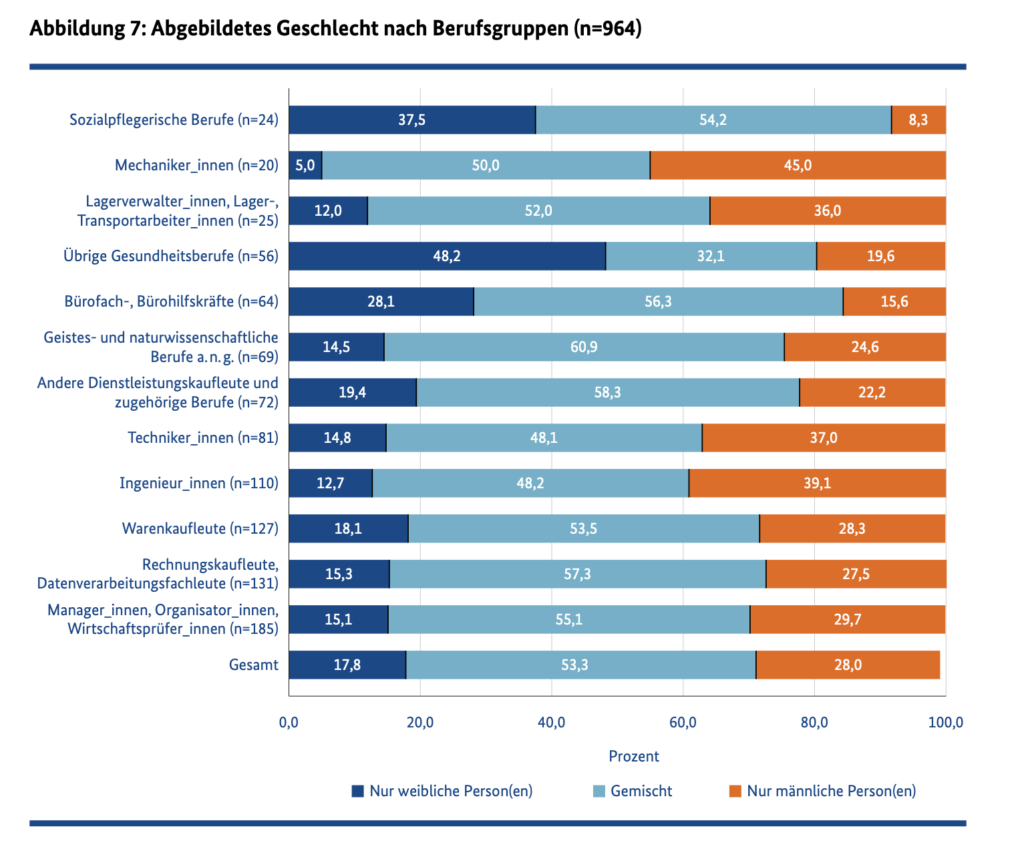
97,8 % der Stellenanzeigen verstoßen nicht gegen das AGG, 2,2 % enthalten Verstöße und jede fünfte Anzeige (21,2 %) enthält ein Diskriminierungsrisiko. Dieses besteht in den allermeisten Fällen deswegen, weil sie nicht geschlechtsneutral sind (80 %) sind. Außerdem besteht ein Zusammenhang zwischen einer Diskriminierung bzw. eines Diskriminierungsrisikos und bestimmten Berufsgruppen, die die Stellenanzeigen ansprechen. Diskriminiert wird am häufigsten in frauendominierten Berufen. Ein Diskriminierungsrisiko besteht hingegen besonders in männlich dominierten Berufen wie Manager*in oder Wirtschaftsprüfer*in. Die meisten Stellenanzeigen sind zudem im generischen Maskulinum verfasst und tragen einen Zusatz wie (m/w/d). Gendergaps oder Gendersternchen werden nur bei 0,2 % der Stellenanzeigen genutzt. Fotos werden häufig genutzt, tragen aber gleichzeitig ein Diskriminierungsrisiko, weil häufig, den Geschlechtsanteilen der Berufe entsprechend, nur Männer (28 %) oder Frauen (19 %) abgebildet werden.
Kritisieren lässt sich an der Studie, dass die Analyse nur innerhalb des gesellschaftlich konstruierten binären Geschlechtssystems erfolgte. Es wurde beispielsweise nicht darauf eingegangen, inwiefern sich trans Personen von Formulierungen in Stellenanzeigen diskriminiert fühlen. Außerdem wurden, bezogen auf visuelle Wirkungen, lediglich Bilder analysiert, nicht aber andere Designelemente. Eine Untersuchung in diesem Bereich wäre interessant.
Was diese allerdings gezeigt haben, ist dass eine gezielte Ansprache von unterrepräsentierten Gruppen in den Stellenanzeigen nur äußerst selten gefunden werden konnte. Nur in 8 % der Stellenanzeigen werden diese spezifisch angesprochen, wenn sie in Unternehmen unterrepräsentiert sind. Für Gruppen wie diese dürfen bei der Formulierung von Stellenanzeigen Ausnahmen vom AGG gemacht werden. Solche könnten dann zum Beispiel sein:
Da aus pädagogischen Gründen die Kinderbetreuung in unserer Kindertageseinrichtung sowohl von weiblichen als auch von männlichen Erziehern erfolgen soll, in unserer Einrichtung bisher aber keine männlichen Erzieher beschäftigt sind, fordern wir Männer besonders auf, sich zu bewerben.
Bezogen auf meine weiterführende Arbeit, wirft dies die Frage auf, inwiefern eine gezielte Ansprache bestimmter Geschlechter mithilfe von visuellen Codes eventuell ebenfalls dadurch legitimiert werden könnte, dem Mittel zum Zweck, wie z.B. der Rekrutierung von mehr Frauen in handwerklichen Berufen dienen zu können. Hier lässt sich allerdings der Zweifel einwerfen, es könnte sich bei visuellen Gestaltungscodes, im Gegensatz zur Sprache, um Konstrukte handeln, die fast immer auf gesellschaftlichen Zuschreibungen von Charaktereigenschaften von oder des Geschmacks eines bestimmten Geschlechtes handeln. Dies gilt es im Folgenden genauer zu erörtern und mittels von (Best Practice) Beispielen zu analysieren.
Literatur
Antidiskriminierungsstelle des Bundes (2018). Diskriminierung in Stellenanzeigen. Studie zur Auswertung von Stellenanzeigen auf Diskriminierung, Ausschlussmechanismen und positive Maßnahmen. Verfügbar unter: https://www.antidiskriminierungsstelle.de/SharedDocs/downloads/DE/publikationen/Expertisen/diskriminierung_in_stellenanzeigen.pdf?__blob=publicationFile&v=3
Heider-Winter C. (2014). Vielfalt gestalten – Unterschiede würdigen: Gender, Diversity und Inklusion als Dimensionen im Employer Branding. In: Employer Branding in der Sozialwirtschaft. Springer Gabler, Wiesbaden. Verfügbar unter: https://doi.org/10.1007/978-3-658-01196-3_4
Hentschel, T. & Horvath, L. K. (2015). Passende Talente ansprechen – Rekrutierung und Gestaltung von Stellenanzeigen. In: C. Peus, S. Braun, T. Hentschel & D. Frey (Hrsg.): Personalauswahl in der Wissen- schaft – Evidenzbasierte Methoden und Impulse für die Praxis. Heidelberg: Springer, S. 65–82.
Jobware (2014). Eye-Tracking-Studie. Leseverhalten bei Online-Stellenanzeigen. Verfügbar unter: http://www.healthcare-personal.de/hcpm/bilder/pdf/Eye-Tracking-Studie.pdf.
Lundquist, H. (2015). Gender Aware Employer Branding: How to Become Authentic, Unique and Attractive. In: Canadian Center of Science and Education (Hrsg.): International Journal of Business and Management. Vol 10., No. 11. Verfügbar unter: https://www.researchgate.net/publication/283699019_Gender_Aware_Employer_Branding_How_to_Become_Authentic_Unique_and_Attractive
Peus, C., Braun, S., Hentschel, T. & Frey, D. (2015): Personalauswahl in der Wissenschaft – Evidenzbasierte Methoden und Impulse für die Praxis. Heidelberg: Springer.
Today’s blogpost is about : listening to nature. But first of all, what means listening ?
Listening is the active process of receiving and responding to spoken (and sometimes unspoken) messages.
Listening is not just hearing what the other party in the conversation has to say. “Listening means taking a vigorous, human interest in what is being told us,” said poet Alice Duer Miller. “You can listen like a blank wall or like a splendid auditorium where every sound comes back fuller and richer.”
So listening to nature can be litterally finding a way to hear it, or inventing more abstracted ways to pay attention to it.
Hearing nature
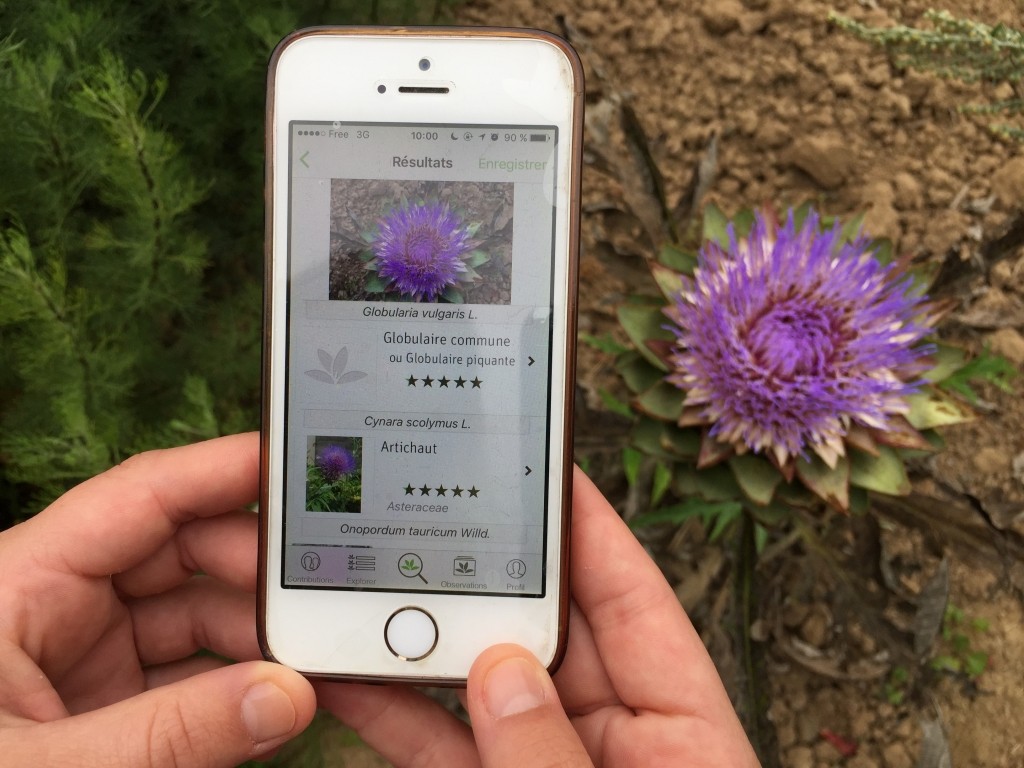
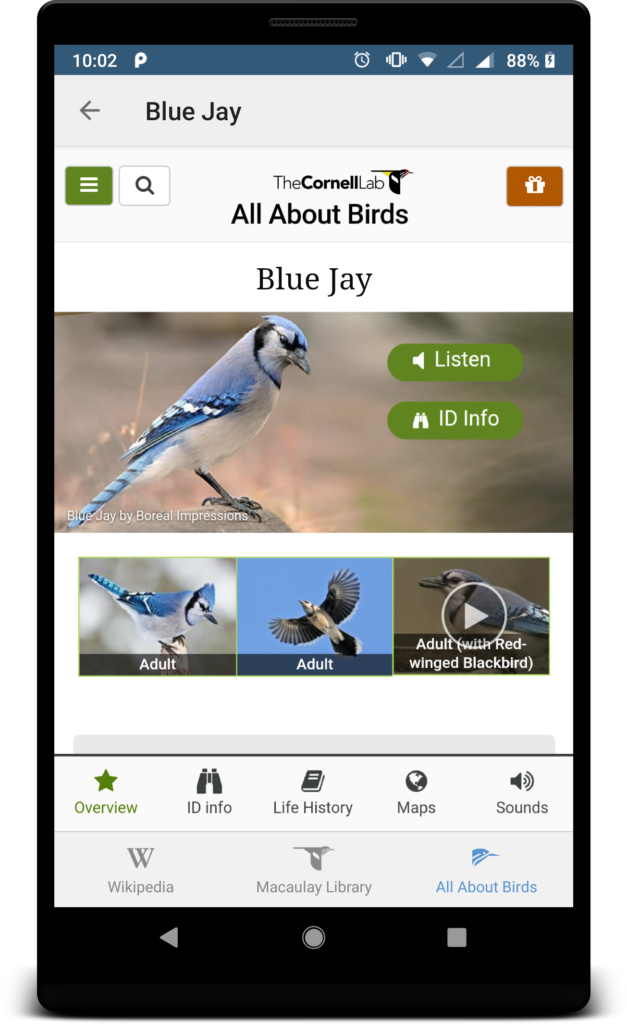
Some applications are making us closer to nature by teaching us names. Maybe you have it in your own pocket ! Pl@ntNet1 gives us plants names if you scan it, BirdNET2 the bird names with their sound… This is not revolutionnary, but at least, putting names on plants or animals we see is a good start to feel closer to them, as knowing other humans name might creates a closer relationships.
Pl@ntNet
BirdNET
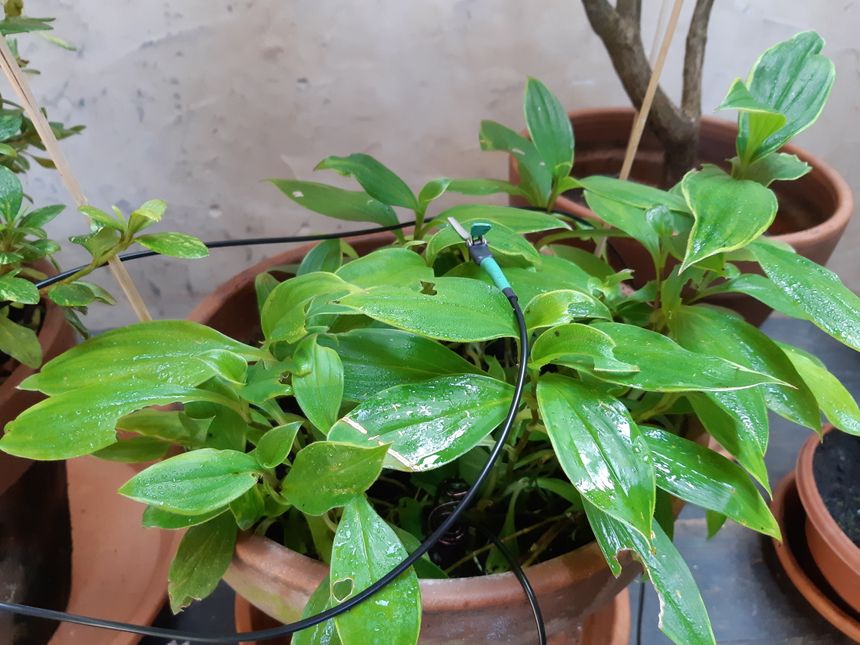
Nowadays, we have way to listen to nature… for real ! With the little help of electronic devices you can transform plant’s elecricity into sound or music3. How does it work ? First, you have to connect some alligator cables to the leaves, roots or stalk of plant. Then, a MIDI device is capting the electrical signal going through the plant, emphasize it and then translate it into music.
Some artists embraced this process and are making concerts with humans and plants, for example, Jean Thoby4. Personnally, I find this kind of music very relaxing and in my head, it is really associated to nature. I couldn’t imagine other sounds coming from it.
France Bleu
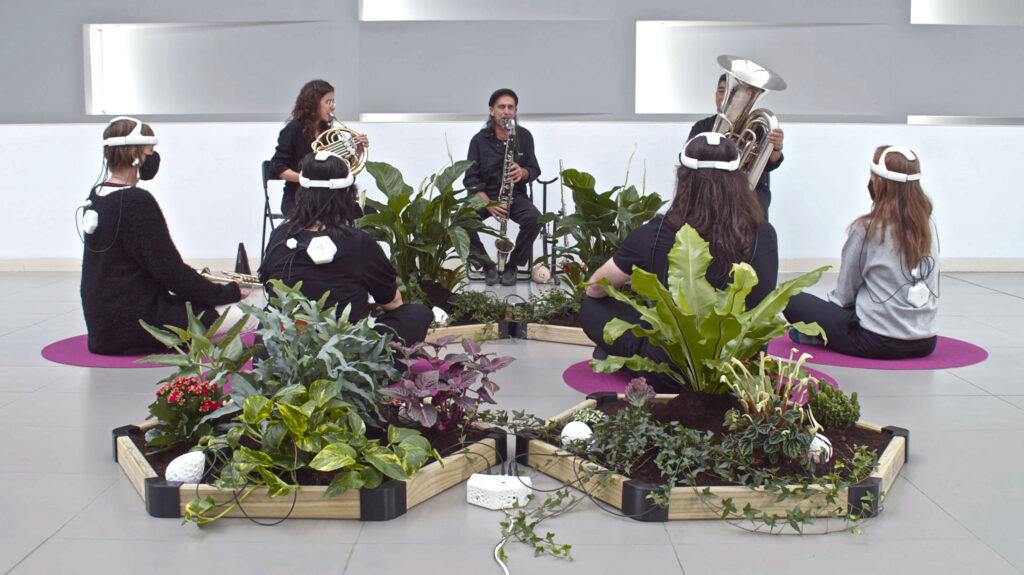
What is also really interesting in this concept is that the sounds depends on every plant and it’s environment. The kind of plant, it’s size, the weather, the wind, the surrounding, all those factors can have an influence on the electrical signal of the plant. This way, humans and plants can interact. The art performance Beyond Perception mesures electrical signals from humans and plants while playing music together to see how thay affect each other5. And the results are quite surprising : impossible to know if you are looking to the plant’s signal or human ! We seem to react the same way to music.
Beyond perception, Maria Castellanos, Alberto Valverde
Giving nature a voice
Now we know we can hear nature like sounds or music. But what about giving it a real voice ? How can we do so ?
For now, I found nothing that was giving nature a voice like humans, but an abstract way to do so is with the creation of a juridical status for a nature entity. In Ecuador, the river Rio Vilcabamba has now a juridical status since 20116. This means that the river can sue every entity that harms it and has power to defend itself.
The Rio Vilcabamba
Listening to nature
We can also use technology associated to nature to understand more in depth the natural changes that can affect humans. A sort of animal internet.
The Kivi Kuaka expedition7 is a french project studying birds behavior to predict natural disasters. Scientists are putting some little GPS chips on the back of birds and then follow their signals. This way, instead of using high tech devices, nature could also gives us informations via birds.
Kivi Kuaka expedition
One way to get closer to nature would be maybe to learn again how to read the signs it gives us. Signs of sickness, signs about the events to come, the weather, the seasons.
Previously we had defined for ourselves what is meant by unisex, however oftentimes when using the expression other terms like “ungendered” and “gender-neutral” pop up. Is there a difference and if any, what differentiates them?
Unisex controversy: is unisex actually unisex?
When researching more into differences between unisex and gender-neutral you come across many articles questioning the integrity of unisex clothing. It is stated that often brands use the term to sound diverse but to only describe clothing that already exists for the different genders like t-shirts and jeans. Moreover, when fashion companies design new unisex clothing lines the fits are often tailored to females, to make more masculine and boxy shapes available for women but often not vice versa. Critics say that these fashion collections also do not include women with more curvy bodies but rather fit the more androgynous looking bodies anyway. Some sources state that exactly this is the difference between unisex and gender-neutral: unisex clothing describes fashion that uses boxy and oversized, masculine fashion to fit both men and slender women, whereas gender-neutral clothing incorporates interchanging fashion for both genders and all body types. The difference to the term ungendered lies in the two genders: gender neutral refers to both and ungendered to none.
Unisex design world: an example of an experiment analysing gender patterns
When talking about unisex fashion design, it is interesting to analyse other design industries that have adapted unisex strategies to attract both genders. Packaging design being the most common, I want to analyse other industries and focus on where a unisex branding strategy and design was adapted. While researching I found an interesting article about gender and its influence on preferences in design for “digital health wearables” or in other words: smartwatches, by Esfahani and Sareh from the “International Journal on Interactive Design and Manufacturing” from 2021.
A study about gender patterns and the differences between the product design of smartwatches
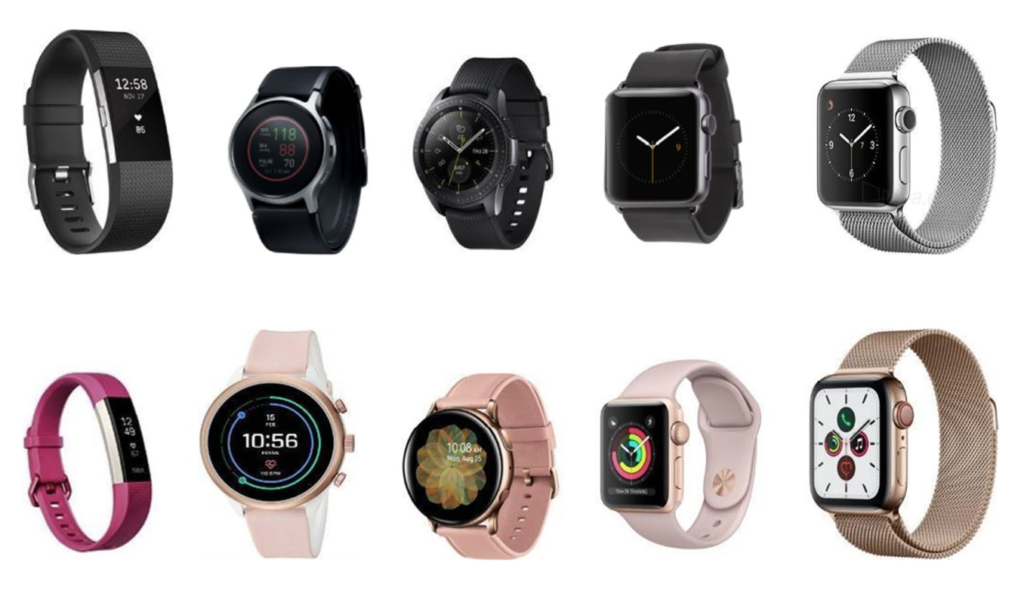
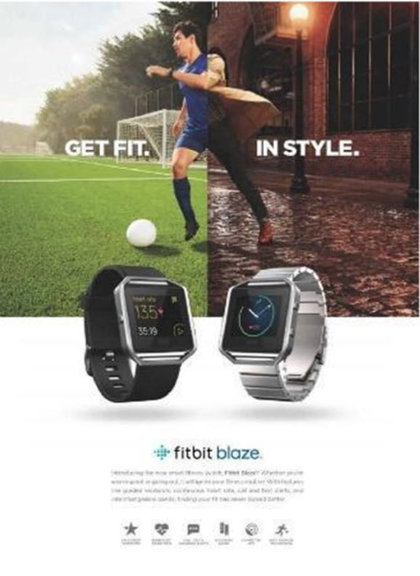
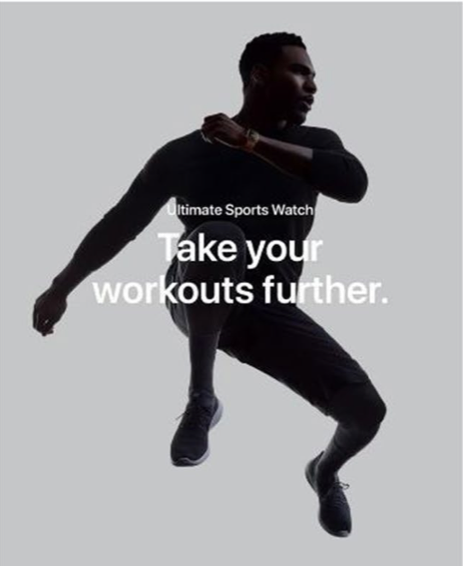
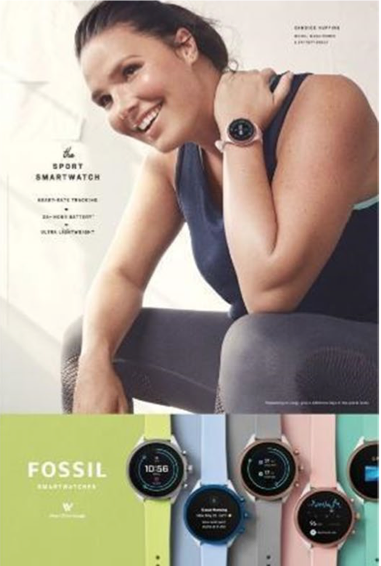
The study conducted within the article included a participatory design session with two groups, one with 3 men and one with 3 women. They were first shown watches from different companies from FitBit, Fossil, Samsung and Apple and advertisements from these companies. The images are shown below.
Top: smartwatches targeted towards men, Bottom: smartwatches targeted towards women, From left to right: Fitbit, Fossil, Samsung and Apple
From left to right: Fitbit, Apple and Fossil
The most interesting findings are listed below:
Theme 1: Gendered aesthetics
All females interested in products targeted towards females
Associated specific colours with specific genders
Associated all gender-neutral products to be more masculine
Especially Apple Watch: masculine, although advertised as gender-neutral
Due to specific features: large square screens & wide straps in silver to be linked to males
In general: attitudes more open to the rules and norms of gender patterns
All males identified product language targeted towards males
Through stereotypical colours such as ‘pink for girls’ and ‘blue for boys’
Classify particular colours as female or male and intentionally assign gender values to products
Dark colours: stereotypical colour for men –> comparison to cosmetic products targeted towards men –> prefer products attached with masculinity
Avoid products not meant for males
Both genders identified gendered colours: dark colours for males & bright colours for females
References from gender imperatives and fears of the norms of appropriate gender stereotypes –> influences of advertising
All participants agreed that smartwatches looked more masculine
Theme 2: Masculinity
All male participants identified following attributes for male targeted advertisements:
minimal information, not long to read, more rigid, infographics to portray info –> less time to read
observations from their gender identity & societal norms
attributes influenced and derived from the society and its expectations (e.g. pressure from peers & parents to behave within traditional gender roles)
often fear of being perceived as homosexual: main motives for young males to act within the stereotypes
My analysis of the results of the study
This study shows precisely what I conveyed above: unisex is a hard design concept to implement within the norms of society as especially for males any attributes that are in any way associated with females are seen as “homosexual” and not fitting within their gender identity. This fragile masculinity that relies on vehemently staying within these roles drives brands to counterfeit this by designing gender-neutral or unisex products more towards male design preferences within gender norms. As a result, females view these as targeted more towards men. This reflects the trends within fashion industry as well, where unisex fashion is often only masculine clothing, like oversized fashion targeted also towards females.
A hypothesis I have formed is that gender neutral clothing in general perhaps has a different target group than the other categories of unisex products, as men that want to wear skirts and more feminine cuts are more secure in their masculinity and do not rely on staying within gender norms. This could also be due to the fact of being genderfluid or -queer or even agender. Therefore, it might be interesting to analyse which target group is interested in gender neutral fashion in general and to analyse other fashion companies and how they advertise to their target group.
Esfahani, Bahar Khayamian, and Pooya Sareh. 2021. “Insights into the role of gender in aesthetic design: a participatory study on the design of digital health wearables.” International Journal on Interactive Design and Manufacturing 173-185.
Morgan, Ashley. 2019. “Why the Terms Unisex and Gender Neutral are not Fit for Purpose in Contemporary Clothing and Fashion Design.” Journal of Textile Science & Fashion Technology.
Warum es wichtig ist, Werte für eine positivere Entwicklung in die persönliche Arbeit mit einzubeziehen wird vor allem dann klar, wenn das Ausmaß und die Geschwindigkeit betrachtet werden, mit welcher der Klimawandel voranschreitet. „Der Mensch“ ist nicht nur verantwortlich für das Aussterben zahlreicher Arten und einen massiven Rückgang der Biodiversität, auch wird dieser Trend auf Kosten einiger Miliarden Menschen ausgetragen, die dafür in Armut leben müssen und Schwierigkeiten haben ihre Lebensqualität aufrecht zu erhalten. Ungefähr 20 Prozent der weltweiten Bevölkerung sind sogenannte „over consumers“, sie verbrauchten 83 Prozent der Ressourcen. Bis zur Mitte des 21. Jahrhundert wird es die größte Herausforderung sein, unter einer stetig wachsenden Bevölkerungszahl die Folgen einer sozialen sowie Klimakrise zu bewältigen.1
Nachhaltigkeit als wicked Problem
Nachhaltigkeit zu erreichen kann auch als “wicked problem” definiert werden. Der Begriff, welcher auf Rittel und Webber (Ulm School of Design) zurückgeht, versucht komplexe Probleme der Gesellschaft zu beschreiben, die sich weder einfach charakterisieren noch endgültig lösen lassen, und nach einer komplexeren Untersuchung sowie ganzheitlichen Lösungsstrategien verlangen.2
Ein wicked problem ist also ein Problem, dass in unzählige weitere, größere Problem-Verstrickungen eingebettet ist, was nicht selten auch mit den unterschiedlichen Perspektiven zu tun hat, aus denen man es betrachten kann.3
(Bieling 2020)
Welche Arten von nachhaltiger Designarbeit gibt es?
Fuad-Luke, Alistair (2009). design activism. beautiful strangeness for a sustainable world. Earthscan. London, S.25
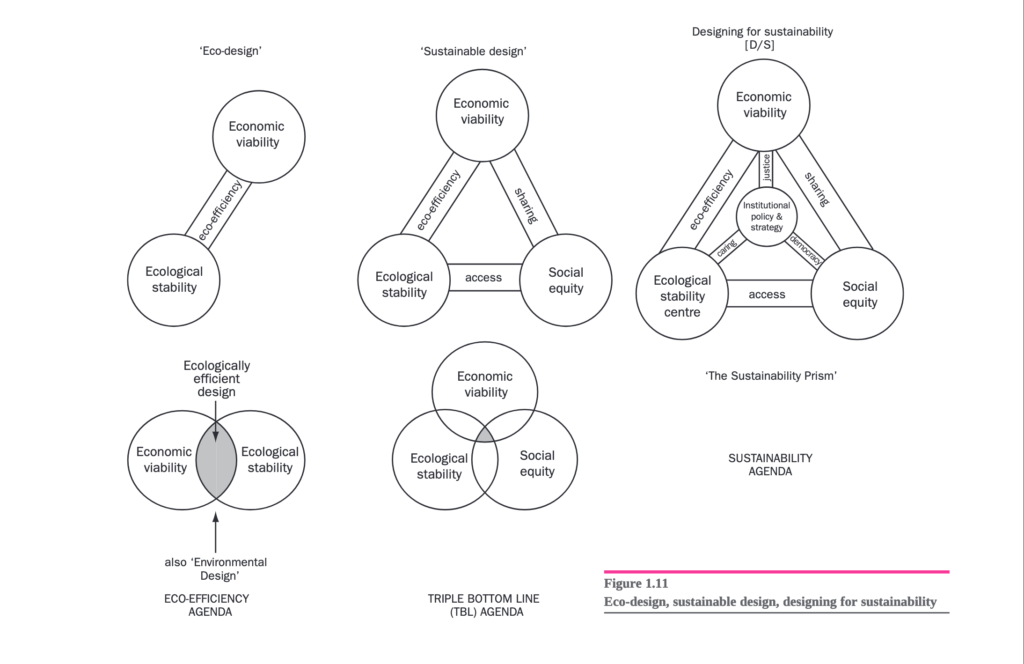
Die Grafik aus dem Buch “Design Activism. Beautiful strangeness for a sustainable world” zeigt das “Nachhaltigkeits Prisma”, welches die ökologischen, ökonomischen, sozialen und institutionellen Strukturen verbindet und deren Unterschiede darstellt.
Leitlinien um Nachhaltigkeit in Designprozesse einzugliedern
Sustainable graphic design is the application of sustainability principles to the field of graphic design. 4
(Ndem 2019)
Ndem beschreibt in seiner Arbeit über die Rolle von Designer*Innen für ökologische Nachhaltigkeit die Orientierung an den vier Säulen: Kultur, Gesellschaft, Ökonomie und Ökologie. Demnach würde nachhaltiges Grafik Design entstehen, wenn sich diese Werte im Gestaltungsprozess selbst sowie in der Wahl der Materialien/des Mediums wiederfinden. Weiters geht es darum diese Werte weiterzugeben.5 Einen weiteren Rahmen für nachhaltige Entwicklung definieren auch die 17 Ziele der Vereinten Nationen in ihrer Agenda 2030(Sustainable Development Goals).6
Weil sich im Design Haltung und Werte manifestieren, können diese dadurch auch aktiv vermittelt werden. Ebenso lassen sich die SDG durch Design in die Sprache und Codes von Produkten, Dienstleistungen, Geschäftsmodellen und Infrastrukturen übersetzen.7
Liedtke, C.; Kühlert, M.; Huber, K.; Baedeker, C. (2019)
Peter Claver Fine empfielt Design-Studierenden sechs Prinzipien, wie sie nachhaltige Werte in ihre Arbeit miteinbeziehen können.
A reform minded approach to design Reform sollte immer ein Bestandteil der Rolle von Design sein.
A holistic approach to design Design sollte interdisziplinär und Medienneutral sein.
An international spirit Auch wenn Design lokal stattfindet, sollte es in einem Konzept von Globalisation betrachtet werden.
A rejection of assumptions Dieser Punkt bezieht sich auch auf vergangene Bewegungen in der Designgeschichte. Jede Avant Garde Bewegung hat ihren Ursprung darin, in Frage zu stellen was Design überhaupt bedeutet oder bedeuten soll.
A commitment to fundamentals Mit der Bekenntnis der Grundlagen beschreibt Fine „truth to materials“ und „truth to process“. Mit der „truth to materials and process“ wird erläutert, dass gewählte Materialien und ihre Produktionsweisen direkte ökologische Auswirkung haben und Designer*Innen durch ihre Wahl auch erheblichen Einfluss auf Weiterentwicklung und Durchsetzungsvermögen haben.8
Designers cannot wait for the right client to come along and offer the opportunity to improve our world. It is in both cases a matter of self-preservation.
Peter Claver Fine (2016)
Quellen:
1 Fuad-Luke, Alistair (2009). design activism. beautiful strangeness for a sustainable world. Earthscan. London
2 Bieling, Tom (2020). Wicked Problems mehr denn je?! Gedanken zu Horst Rittel. In: DESIGNABILITIES
Design Research Journal, (07). https://tinyurl.com/ya6h3ayh ISSN 2511-6274 (3.12.2021)
3 Bieling, Tom (2020). Wicked Problems mehr denn je?! Gedanken zu Horst Rittel. In: DESIGNABILITIES
Design Research Journal, (07). https://tinyurl.com/ya6h3ayh ISSN 2511-6274, S. 2 (3.12.2021)
4 Ndem, Emmanuel Joseph (2019). The place of a graphic designer in environmental sustainability. in: International Journal of Engineering Applied Sciences and Technology. Vol. 4. 251-257
5 Ndem, Emmanuel Joseph (2019). The place of a graphic designer in environmental sustainability. in: International Journal of Engineering Applied Sciences and Technology. Vol. 4. 251-257
6 United Nations. Global Sustainability Goals. https://sdgs.un.org/goals (3.12.2021)
7 Liedtke, C.; Kühlert, M.; Huber, K.; Baedeker, C. (2019): Transition Design Guide – Design für Nachhaltigkeit. Gestalten für das Heute und Morgen. Ein Guide für Gestaltung und Entwicklung in Unternehmen, Städten und Quartieren, Forschung und Lehre. Wuppertal Spezial Nr. 55, Wuppertal Institut für Klima, Umwelt, Energie. Wuppertal. Online verfügbar: https://wupperinst.org/design-guide ISBN 978-3-946356-13-4
8 Claver Fine, Peter (2016). Sustainable Graphic Design: Principles and Practices. Bloomsbury Academic.
Hello again! In this 3rd blog entry I will give an overview of the technology behind AR that makes the magic happen. Let’s go.
Technology
To superimpose digital media on physical spaces in the right dimensions and at the right location 3 major technologies are needed: 1) SLAM, 2) Depth tracking and 3) Image processing & projection
SLAM (simultaneous location and mapping) renders virtual images over real-world spaces/objects in the right dimensions. It works with the help of localizing sensors (i.e. gyroscope or accelerometer) that map the entire physical space or object. Today, common APIs and SDKs for AR come with built-in SLAM capabilities.
Depth tracking is used to calculate the distance of the object or surface from the AR device’s camera sensor. It works the same a camera would work to focus on the desired object and blur out the rest of its surroundings.
Then the AR program will process the image as per requirements and projects it on the user’s screen (For further information on the “user’s screen” see section “AR Devices” below). The image is collected from the user’s device lens and processed in the backend by the AR application.
To sum up: SLAM and depth tracking make it possible to render the image in the right dimensions and at the right location. Cameras and sensors are needed to collect the user’s interaction data and send it for processing. The result of processing (= digital content) is then projected onto a surface to view. Some AR devices even have mirrors to assist human eyes to view virtual images by performing a proper image alignment.
Object detection
There are two primary types used to detect objects, which both have several subsets: 1) Trigger-based Augmentation and 2) View-based Augmentation
Trigger-based Augmentation
There are specific triggers like markers, symbols, icons, GPS locations, etc. that can be detected by the AR device. When pointed at such a trigger, the AR app processes the 3D image and projects it on the user’s device. The following subsets make trigger-based augmentation possible: a) Marker-based augmentation, b) Location-based augmentation and c) Dynamic augmentation.
a) Marker-based augmentation
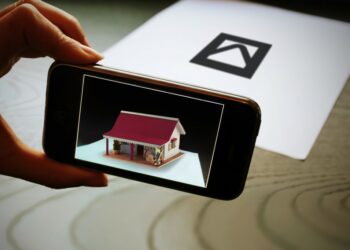
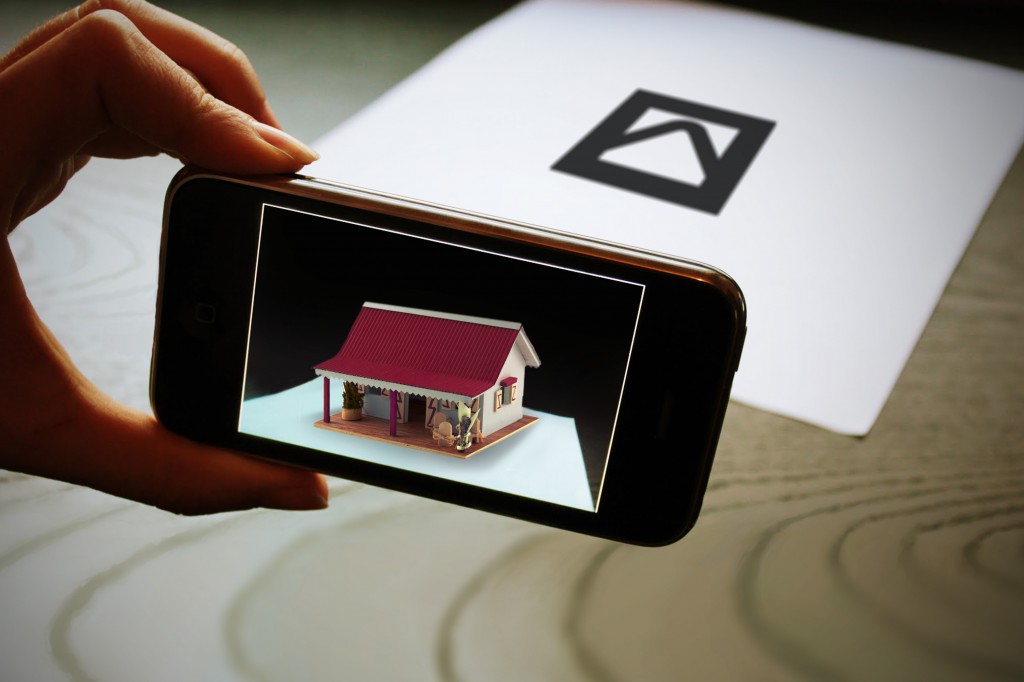
Marker-based augmentation (a.k.a. image recognition) works by scanning and recognizing special AR markers. Therefore it requires a special visual object (anything like a printed QR code or a special sign) and a camera to scan it. In some cases, the AR device also calculates the position and orientation of a marker to align the projected content properly.
Example for marker-based augmentation with a special sign as trigger
b) Location-based augmentation
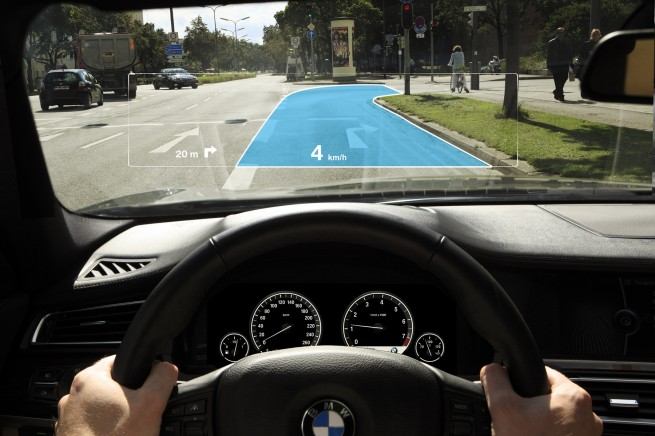
Lacotion-based (a.k.a. markerless or position-based augmentation) provides data based on the user’s real-time location. The AR app picks up the location of the device and combines it with dynamic information fetched from cloud servers or from the app’s backend. I.e. maps and navigation with AR features or vehicle parking assistants work based on location-based augmentation.
BMW’s heads-up display as an example of location-based augmentation
c) Dynamic augmentation
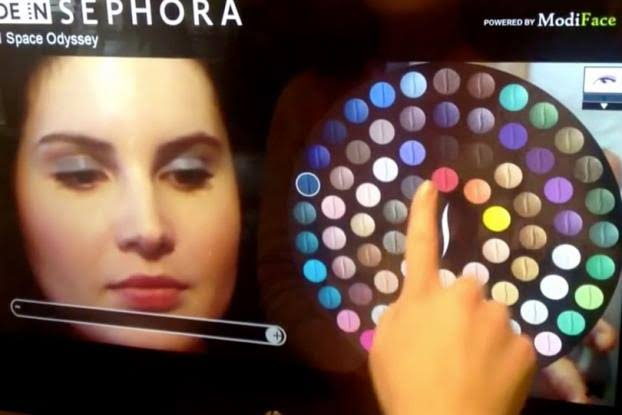
Dynamic augmentation is the most responsive form of augmented reality. It leverages motion tracking sensors in the AR device to detect images from the real-world and super-imposes them with digital media.
Sephora’s AR mirror as an example of dynamic augmentation. The app works like a real-world mirror reflecting the user’s face on the screen.
View-based Augmentation
In view-based methods, the AR app detects dynamic surfaces (like buildings, desktop surfaces, natural surroundings, etc.) and connects the dynamic view to its backend to match reference points and projects related information on the screen. View-based augmentation works in two ways: a) Superimposition-based augmentation and b) Generic digital augmentation.
a) Superimposition-based augmentation
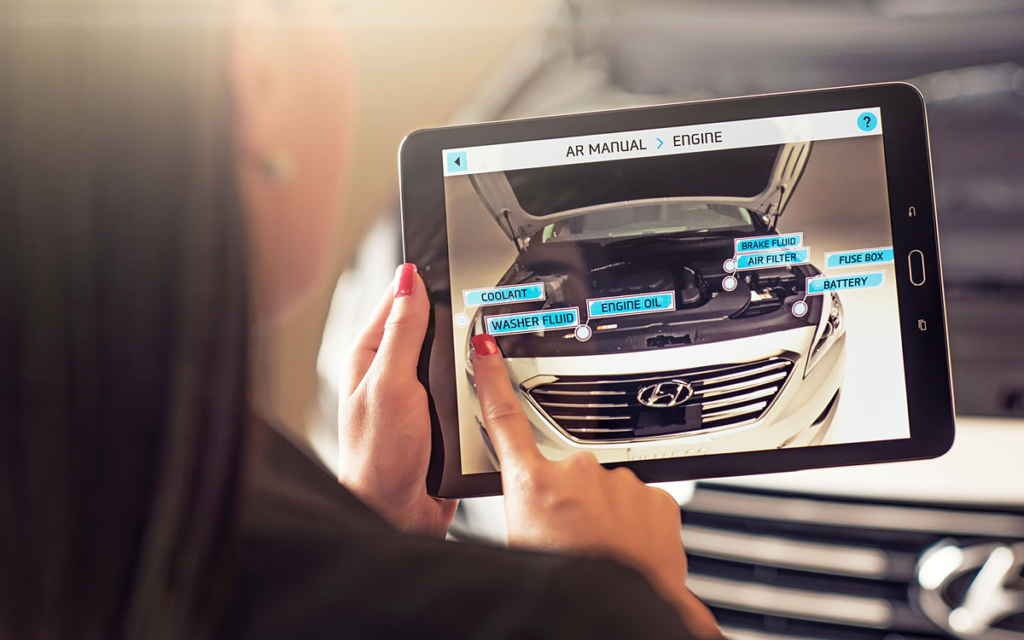
Superimposition-based augmentation replaces the original view with an augmented (fully or partially). It works by detecting static objects that are already fed into the AR application’s database. The app uses optical sensors to detect the object and relays digital information above them.
Hyundai’s AR-based owner’s manual allows users to point their AR device at the engine and see each component’s name + instructions for basic maintenance processes.
b) Generic digital augmentation
Generic digital augmentation is what gives developers and artists the liberty to create anything that they wish the immersive experience of AR. It allows rendering of 3D objects that can be imposed on actual spaces.
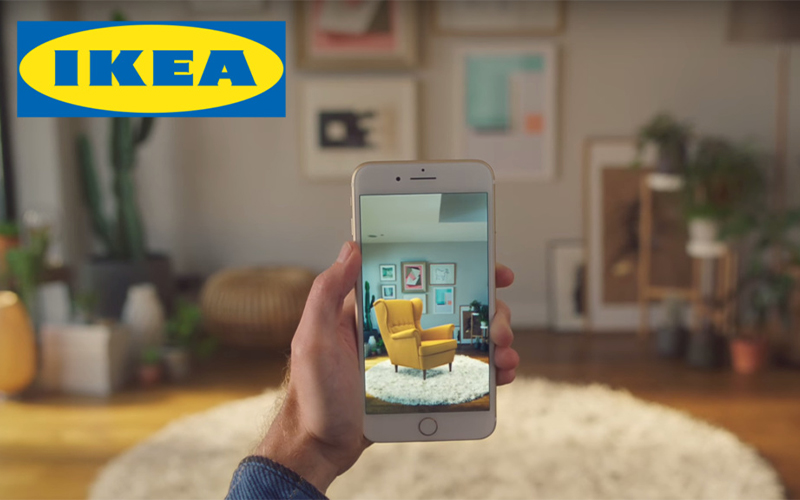
The IKEA catalog app allows users to place virtual items of their furniture catalog in their rooms based on generic digital augmentation.
It’s important to note that there is no one-size-fits-all AR technology. The right augmented reality software technology has to be chosen based on the purpose of the project and the user’s requirements.
AR Devices
As already mentioned in my previous blog entry, AR can be displayed on various devices. From smartphones and tablets to gadgets like Google Glass or handheld devices, and these technologies continue to evolve. For processing and projection, AR devices and hardware have requirements such as several sensors, cameras, accelerometer, gyroscope, digital compass, GPS, CPU, GPU, displays and so on. Devices suitable for Augmented reality can be divided into the following categories: 1) Mobile devices (smartphones and tablets); 2) Special AR devices, designed primarily and solely for augmented reality experiences; 3) AR glasses (or smart glasses) like Google Glasses or Meta 2 Glasses; 4) AR contact lenses (or smart lenses) and 5) Virtual retinal displays (VRD), that create images by projecting laser light into the human eye.
Albeit having used Google Scholar to find scientific articles extensively while writing my Bachelor’s thesis, I never considered using it for my Extended Guitar performance project – until today. It was a good decision for I discovered some great articles that deal with electric guitars and possibilities to further extend or evolve their sonic capabilities. One of these articles is briefly summarised below.
MIDI Pick
The first article I found documents the development of the so-called MIDI Pick. This special pick serves a dual purpose: on one hand, it can be used as a conventional pick to pluck the strings of an electric guitar and on the other hand, it functions as a pressure trigger, interpreting finger pressure exerted on it as analog or digital values. The pick itself is made of wood, rubber and double-sided tape with a force-sensing resistor mounted on it. The sensor is connected to an Arduino microcontroller and Bluetooth module is used to transmit the data by wireless means. The two latter items are attached to strap worn around the wrist. As already mentioned, the MIDI pick needs to be squeezed and the harder the pressure, the higher a numerical number is outputted. The output is received by a MSP/Max patch that relays the data to other patches. Furthermore, the MIDI pick can operate in serial or switch mode with the mode being controlled by a switch on the wrist. In serial mode, values between 0 and 127 are transmitted. In the switch mode, the pick sends a 1 when the pressure exceeds a certain threshold and a 0 when that pressure is exceeded again, essentially making the pick a toggle switch. In a live performance test, the developer successfully tested the MIDI pick, using it as a controller for a white noise generating patch. In this context, the developer also noted that being capable of adequately using the MIDI pick necessitated time and practice. The 2006 article also spoke about a future outlook involving a updated version of the MIDI pick, however, I did not find another article documenting the further development process of the pick.
Personal thoughts
This article is definitely interesting for my project because the latter will also involve using the pick one way or another to add to the sonic capabilities of the guitar. In fact, the notion of placing a pressure sensor opened a whole new world of possibilities for me as far as sensors are concerned. Let me explain: Until now, I only thought about mounting an accelerometer/gyroscope/IMU kind of sensor on the pick or the back of the hand in order to register e.g. the strumming movements of the hand. However, I see now that I need not to restrict my thinking to the afore mentioned sensors alone. While the idea of using a pressure sensor is evidently taken (XD), I immediately thought of a touch sensor, more precisely, a capacitive touch sensor. A capacitive touch sensor measures touch based on electrical disturbance from a change in capacitance and not based on pressure applied (in contrast to a resistive touch sensor). As far as applications in a guitar context are concerned, such a touch sensor may be used to trigger or activate an effect by double tapping on the pick for example. Admittedly, double tapping would not be possible with a conventional pick that needs to be held between thumb and forefinger all the time. However, by using a so-called thumb pick, a pick that is strapped to the thumb, the forefinger would be free to tap onto the underside of the pick in order to trigger a certain value. This idea will certainly find its way into my final project concept. Beyond that, the article also shows that it is possible to place a sensor on a pick without compromising playability.
I dedicated this weekend to a first round of finding similar reference works and publications since this is also one of the tasks due for the Exposé.
Imogen Heap’s Mi.Mu gloves
One of the artists I stumbled upon during my research that makes use of hand movements and gestures to perform and compose her music is Imogen Heap. Considered a pioneer in pop and electropop music, she is a co-developer of the so-called Mi.Mu gloves, gesture controllers in glove form that Heap uses to control and manipulate recorded music and/or her musical equipment during a (live) performance.
As she explained in an interview with Dezeen, Heap found the conventional way of playing keyboards or computers on stage very restrictive since most of her actions like pressing buttons or moving a fader were hidden from the audience and thus not very expressive, even though they may constitute a musically important act. Her goal was to find a way to play her instruments and technology in a way that better represents the qualities of the sounds produced and allows the audience to understand what is going on on stage.
Inspired by a similar MIT project in 2010, the gloves underwent eight years of R&D, with the development team consisting of NASA and MIT scientist alongside Heap. While Heap has used prototypes for several years now during her live performances, also other artists were occasionally seen to try them out. Ariana Grande for example used the gloves on her 2015 tour. In July 2019, the Mi.Mu gloves became commercially available for the first time promising to be “the world’s most advanced wearable musical instrument, for expressive creation, composition and performance”.
The Mi.Mu gloves contain several sensors including:
an accelerometer, a magnetometer, and a gyroscope in the form of an IMU motion tracker, located at the wrist, that gives information regarding the hand’s position, rotation and speed
a flex sensor over the knuckles to identify the hand’s posture in order to interpret certain gestures
a haptic motor that provides the “glove wielder” with haptic feedback: it vibrates for example if a certain note sequence is played
To send the signals to the computer, the gloves use WLAN and Open Sound Control (OSC) data instead of MIDI data. The gloves themselves are made from e-textiles, a special kind of fabric that acts as a conductor for information. Furthermore, the gloves come with the company’s own Glover software to map your own custom movements and gestures which can be integrated into DAWs such as Ableton Live or Logic Pro X.
Unfortunately, the Mi.Mu gloves still cost about £2,500 (converted about 3,000 €) and are, on top of that, currently sold out due to the worldwide chip shortage. A limited number of gloves is expected to become available in early 2022.
Key take-aways for own project
First of all, Heap’s Mi.Mu gloves serve to confirm the feasibility of my project since the technology involved is quite similar. The gloves also use an IMU sensor which is also my current go-to sensor to track the movements of a guitar player’s hands. Although Heap mostly uses the gloves to manipulate her voice, I found a video that shows her playing the keyboard in between as well. This shows that wearing the sensors on one’s hands does not necessarily interfere with playability of an instrument which is a very important requirement for my project.
Interestingly, the gloves rely on WLAN and OSC instead of MIDI which is definitely a factor that calls for additional research from my side. OSC comes with some advantages over MIDI especially as far as latency and accuracy are concerned which makes it ideal for use in real-time musical performances. Furthermore, data is conveyed over LAN or WLAN which eliminates the need for cables. Moreover, OSC is supported by open-source software such as Super Collider or Pure Data which could make it even more attractive for my project.
Finally, I want to use Imogen Heap and her glove-supported performances as a source of inspiration in order to come up with playing techniques or effect possibilities for my own project.
In order to approach the problem from the initial topic, which aims to study interaction for children in educational exhibitions, it is necessary to divide the problem into parts.
Therefore and starting from the beginning, it is time to study and analyse the differences in UX for adults and children. Creating an interface for kids is not simply a matter of using something made for adults and then changing the language for “dummies”. Designing interfaces for children goes much further than that.
One of the most important and most frequently mentioned issues throughout the different articles reviewed is the importance of focusing the design on the right age group. The age steps in children are much stronger than in adults. When we create a prototype aimed at older people, we can determine a target with an age range of 20 years difference. In contrast, in children the difference of 4 years of age already implies big changes related to skills and abilities. That is why in the next analyses we will try to focus the search on a target age range of 6 to 8 years, ages at which children are able to read, but still have a limited vocabulary.
After reading a large number of articles related to the subject, we have extracted the most important points (even though they may sometimes seem obvious) that have been most frequently repeated among authors. Some of the things to keep in mind are:
Children need instant feedback with every action. This means not only informing the user that something has been clicked, but also keeping in mind that problems need to be broken down into small pieces.
Multiple navigation is complicated to understand, so it is easier for them to receive information in the form of a story. This means that storytelling is key in children’s interfaces.
Reading ability varies with age, but it is true that children usually avoid reading. So, if texts are added, they should be very concise, adapted and direct.
The adaptability of the interface takes into account several concepts such as font size and colour. In case of interfaces for children, font sizes should always be between 12pt and 14pt and colours should be saturated and vivid. This is a concept that normally in interfaces for adults can be distracting, but it is something that keeps children interested and connected with the content. A similar idea includes the use of sounds and animations.
Children tend to have an explorative attitude towards interfaces, “mine-sweeping” the screen.
Finally, it is important to bear in mind that children tend to take everything they see literally, so it is necessary to think deeply about the use of icons and images.
With this little research, it is time to look at existing children’s displays that may or may not meet these points.
Nun hatte auch ich das erstes Gespräch mit meinem Betreuer. Die erste Idee “Foley App” fand auch er sehr interessant und nützlich. Jedoch legte er mir nahe, dass beim Umsetzen dieses Projektes App-Programmier-Skills notwendig wären, da es ihm nicht reichen würde, wenn ich den Inhalt & das Screen Design der App gestalten würde. App-Programmierung zu lernen ist für mich keine Option, da ich nicht die nötigen Ressourcen dafür besitze.
Ich finde es einerseits sehr schade, da ich wirklich großes Potential in der Idee gesehen habe und ich sehr gern etwas erschaffen würde, dass wirklich praktische Verwendung findet. Zumindest in meinen Arbeitsprozessen. Jedoch verstehe ich die Entscheidung meines Betreuers ebenso.
Wir entschieden uns dann für die 2. Idee, die Installation. Ich bin nicht wirklich zufrieden mit der Entscheidung, da diese Idee eine eher obligatorische war, um auf insgesamt 3 Ideen zu kommen. Nicht dass es mich nicht reizt eine solche Installation zu erschaffen, jedoch ist das Interesse im Verhältnis zur Foley App relativ gering.
Nichtsdestotrotz werde ich mich nun in diese Richtung weiter Orientieren, und überlege mir mit Pure Data zu arbeiten.