Hololive, VShojo und Co. Agenturen und ihre Stars

Um als sich als Vtuber einen Namen machen zu können, hat sich gezeigt, dass das Beitreten in eine Agentur nicht nur empfehlenswert sondern sogar unerlässlich ist. Diese sogenannten “Vtuber agencies” sind Unternehmen, die Vtuber als Klienten aufnehmen und in ihre Talente und Fähigkeiten als Unterhaltungskünstler investieren. Also ähnlich einer normalen Agentur für Schauspieler und Künstler.

Einer der Vorteile dieses Geschäftsverhältnisses zwischen Vtuber und Vertreter ist die Möglichkeit Aufnahmen in, für die virtuellen Youtuber zur Verfügung gestellten Studios.
Außerdem erlangen die Protagonisten erst durch ihre Agentur an Bekanntheit. Besonders durch Kollaborationen zwischen Vtubern innerhalb eines Unternehmens können diese so leichter zu dieser zugeordnet werden.

Die Kehrseite der Medaille liegt momentan noch in der fehlenden Transparenz. So stellen sich die Frage, wie hoch der Anteil der Einnahmen ist, die aus den Spenden von Superchats auf Plattformen wie beispielsweise Twitch entstehen.
Auch ist nichts über die Verantwortung der Agentur gegenüber ihren angestellten Vtubern bekannt. Es bleibt daher auch unklar, ob die virtuellen Stars eines Unternehmens auch dann eine Gehalt erhalten, wenn sie kein Geld einbringen.

Agenturen aus Japan

Nijisanji, source: https://1.bp.blogspot.com/-sL6H0W432Sg/XyKVHUD_jhI/AAAAAAAABlA/s9kL9oARbNg_GHeY-tI3IUKNxJbuc4LEwCLcBGAsYHQ/s1600/Cover%2BIssue.jpg

Nijisanji Project

NIJISANJI ist eine Agentur aus Vtubern und sogenannten “Virtual Livern”, die durch Veranstaltungen, Musikproduktionen und der Vermarktung von digitalen Inhalten eine neue Generation an Unterhaltung schaffen will.

Unterstützt werden die Content-Creator durch das Management bei ihrem Debüt und täglichen Streaming-Auftritten, sowie die Erstellung von Live2D- und 3D-Modellen. Websites, Web- und Smartphone-Anwendungen und unternehmensinterne Systeme werden von der Agentur ebenfalls bereitgestellt.
Außerdem bietet NIJISANJI Project seinen Mitgliedern eine Plattform an, um ihren Kontent zu präsentieren (beispielsweise in Form von Internet-, Radio-, oder Fernsehauftritten) und sorgt für die nötige Publicity.

VTuber

Die Content-Creator von Nijisanji Project stammen hauptsächlich aus Japan, jedoch gibt es auch Übersee-Mitglieder aus Indonesien, Korea und dem englischen Sprachraum.

Kuzuha (JPN)

“Give me your money or blood.”

geldgieriger Gamer-Vampir, lebt mit seinem Hausschwein zusammen

Tags: Gaming

Hana Macchia (IDN)

“Ini kopi untuk kamu yang udah membaca ini.”

fleißige Nachteule, leistet allen Nachtaktiven Gesellschaft

Tags: Gaming, Just Chatting, Singing

Lee Roha (KOR)

“よろしくお願いいたします❣”

quirrliges Idol mit koreanischen Wurzeln, sorgt für Unterhaltung

Tags: Singing, Drawing, Gaming, Just Chatting

Elira Pendora (ENG)

“Let’s make lots of fun memories together!!”

freundlicher Himmelsdrache, lässt sonniges Tageslicht fallen

Tags: Singing, Gaming, Just Chatting

Hololive, source: https://s3.us-east-1.amazonaws.com/dexerto-assets-production-cbbdf288/uploads/2021/02/14071507/Hololive-Editorial.jpg

Hololive Production

Mit über 35 Millionen Fans (Stand: März 2021) auf YouTube ist hololive Production eine beliebte VTuber-Agentur nicht nur in Japan, sondern auf der ganzen Welt.

Die Hauptdienstleistungen der Agentur bestehen in der Entwicklung von Vertriebssystemen, dem Verwalten von VTuber-Büros und der Entwicklung von Inhalten für Vtuber.
Auch die Erstellung von 2D- und 3D-Charaktermodellen und die Bereitstellung von Anwendungen zur Erkennung von Gesichtsausdrücken und Körperbewegungen auf der Grundlage von Smartphones und Motion-Capture-Geräten bietet Hololive seinen Vtubern an.

Die Agentur entwickelt virtuelle Live-Dienste, die es Fans aus aller Welt ermöglichen, das Live-Erlebnis auch dann zu genießen, wenn sie nicht vor Ort sein können, indem sie per Smartphone oder PC teilnehmen.
3D-Kurzanimationen und Musikvideos mit den Mitgliedern von “HOLOLIVE” sind auf dem offiziellen Kanal verfügbar und erreichen eine Vielzahl von Nutzern, darunter auch Fans in Übersee.

Neben Werbekampagnen für Spiele- und Lebensmittelhersteller und gemeinsamen Gacha-Kampagnen haben die Vtuber von Hololive auch in Fernsehserien mitgewirkt und eine Reihe von Projekten als Talente entwickelt.
Die Produktion von Original-Songs für jede Gruppe und jeden einzelnen virtuellen Content-Creator sind weitere Features, die die Agentur anbietet. Diese werden dann auf organisierten Live-Auftritten in Form von AR Live umgesetzt.

VTuber

Hololives Vtuber sind ebenfalls ursprünglich aus Japan, jedoch gibt es auch hier Übersee-Mitglieder aus Indonesien und dem englischen Sprachraum.

Tokino Sora (JPN)

“How’s it going, Soratomos! It is Tokino Sora!”

erstes Idol von Hololive, träumt davon ein Live-Konzert in der Yokohama-Arena zu halten

Tags: Singing, Gaming

Airani Iofifteen (IDN)

“Jangan lupa nyalakan telepati kalian ya 人´∀`)”

Alienmädchen, das gerne malt, mag die Erde so gern, dass sie einfach hiergeblieben ist

Tags: Just Chatting, Drawing

Mori Calliope (ENG)

Mori Calliope, source:
https://user-images.strikinglycdn.com/res/hrscywv4p/image/upload/c_limit,fl_lossy,h_9000,w_1200,f_auto,q_auto/1369026/113636_835642.png

erster Lehrling des Sensenmanns, sammelt Seelen, liebt Hardcore-Metal

Tags: Singing, Just Chatting,

VSPO!, source: https://vspo.jp/wp-content/themes/vspo/assets/images/index/VspoTOP_1_2.png

Virtual eSports Project VSPO!

“VSPO!” ist ein virtuelles eSports-Projekt, deren Mitglieder sich ernsthaft mit Games beschäftigen, um die Vorzüge des eSports zu verbreiten. Dabei versuchen die Vtuber eine Vielzahl von Medienmixen zu entwickeln, wie z. B. Vertriebsaktivitäten als VTuber, Teilnahme an eSports-Turnieren, Animation und Comics.

Vtuber

Es gibt vier Gruppen von Vtubern innerhalb von VSPO!: Mitglieder von Lupinus Virtual Games, Mitglieder der Iris Black Games, Mitglieder von Cattleya Regina Games und Einzelmitglieder.

TOTO KOGARA

Lupinus Virtual Games

kümmert sich meistens um sich selbst, gut im Umgang mit Scharfschützenwaffen

Tags: Gaming

HINANO TACHIBANA

Iris Black Games Affiliation

einsames Mädchen, das Spiele und Gesang liebt,
eine der besten Spielerinnen in Apex Legends

Tags: Gaming

SENA ASUMI

Cattleya Regina Games Affiliation

exotischer kleiner Teufel, liebt es, Menschen glücklich zu machen

Tags: Gaming

QPI KAMINARI

Solo member

gebräuntes Mädchen, liebt Energydrinks,
aber im Herzen ist sie eine ernste und fleißige Person

Tags: Gaming

Internationale Konkurrenz

VShojo, source: https://i.ytimg.com/vi/UXKTzgAoCqI/maxresdefault.jpg

Vshojo

VShojo ist ein amerikanisches talentorientiertes VTuber-Unternehmen, das sich für das Wachstum und den Erfolg seiner Mitglieder einsetzt. Gegründet wurde es von den Fans der VTuber-Kultur, um Inhalte zu erstellen und zu fördern, die die Grenzen zwischen Realität und VR verschmelzen lassen.

Autonomie ist ein großes Thema für die VShojo. Die Conten-Creator sind absolut frei in ihrer Inhaltsgestaltung und können jegliche Themen so behandeln und umsetzen, wie sie es für richtig halten.
Mitglieder arbeiten nach ihren eigenen Zeitplänen und werden auch nicht angekauft. Jedoch bietet VShojo seinen Vtubern wettbewerbsfähige Vertäge an, die als Anreiz dienen sollen.

Die Agentur unterstützt alle Mitglieder mit Unterstützung, Management und Öffentlichkeitsarbeit. Sie nutzt ihr starkes Netzwerk aus jahrelanger Erfahrung im Bereich Streaming und Content Creation, um die Talente und Träume der Content-Creator zu unterstützen.

Vtuber

VShojo verzichtet auf das erstellen von eigenen Generationen, das bedeutet, dass jedes neue Mitglied von Vshojo als gleichwertiger Teil der Agentur aufgenommen wird. Alle Vtuber produzieren Inhalte für den englischen Sprachraum, was zu einer wesentlich größeren Reichweite führt. Dennoch haben einige Vertreter zumindest eine Zweitsprache, die sie innerhalb ihrer Streams benutzen.

Nyatasha Nyanners

“Hyello everynyan!”

uralte böse Kreatur, hat die Form eines rosa behaarten Katzenmädchens angenommen

Tags: Just Chatting, Singing, Gaming

Projekt Melody

“I’m illegal in several countries!!!”

hat Probleme beim Zählen und ihr fehlen lebenswichtige Organe, gesündeste Perverse, freundlich

Tags: Just Chatting, Gaming

Ironmouse

“Hola hola holi, It is I… ME!”

Dämonenkönigin, ist vor ihren Pflichten geflohen um neue Freunde zu finden, hängt an ihren Glöckchen

Tags: Singing, Just Chatting, Gaming

PITAPAT
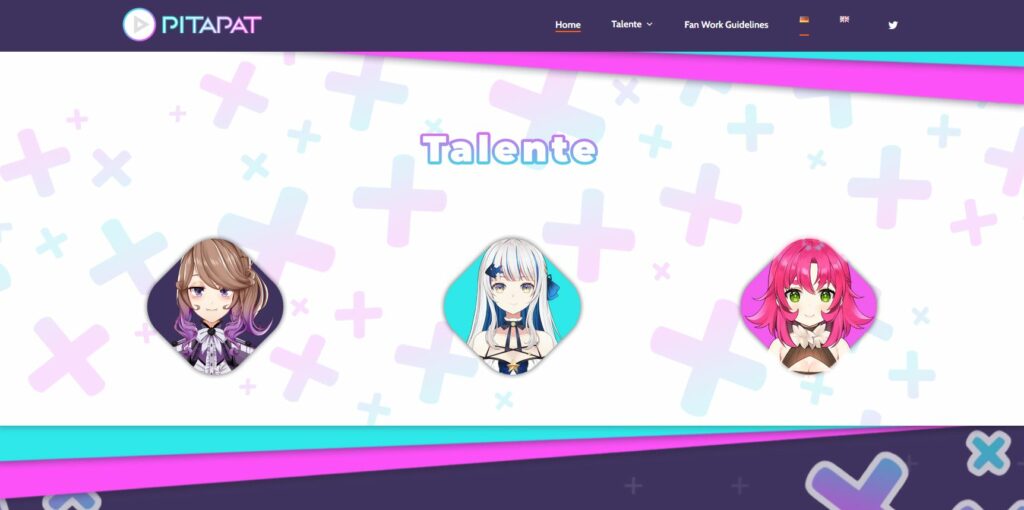
PITAPAT, source: https://pitapat.de/de/home-deutsch/

PITAPAT ist ein deutsches VTuber-Projekt, das von Fans gegründet wurde.
Das Ziel der Agentur ist es, Individualität und kreative Freiheit in den Vordergrund zu stellen und die deutsche V-Tuber-Community zu unterstützen. Mitglieder können ihre Talente und Inhalte so präsentieren, wie sie es möchten. Eine lockere und unterhaltsame Atmosphäre zu schaffen, für das Team und die Zuschauer ist das Ziel von PITAPAT. Dabei soll der globalen Trend aus Japan von Düsseldorf aus für den europäischen Markt angepasst verbreitet werden.

Vtuber

Bis zum heutigen Tag (11.12.2021) besteht die Agentur nur aus 3 Mitgliedern:

Karen von Nachtigall

“„Moin Moin!“

Vampir Vtuber aus Deutschland, hat eine Vorliebe für Sprachen und Karaoke

Tags: Education, Gaming, Singing

Meena Caleano

„Oii!“

Meena Caleano,
source: https://pitapat.de/wp-content/uploads/2021/04/image51-5-e1618698706199.png

melodische Astrologin, plaudert gerne über Musik und die Galaxie

Tags: Singing, Just Chatting

Taya Rex

„Raawr!“

kleine abenteuerlustige Gamerin aus der Kreidezeit

Tags: Gaming

Demnächst

  • Bedeutung, Entstehung und aktueller Bezug
  • V-Tuber Agenturen und ihre Protagonisten
  • Software und Programme – Was gibt es und wie verwende ich sie?
  • Entwicklung eines Characters – 2D und 3D Modell

Literaturverzeichnis

ANYCOLOR, Inc. (17.05.2021): NIJISANJI Project, https://www.anycolor.co.jp/en/service/nijisanji, in: https://www.anycolor.co.jp/en/service [11.12.2021]

ANYCOLOR, Inc. (17.05.2021): NIJISANJI Official Website, https://www.nijisanji.jp/en/members, in: https://www.nijisanji.jp/en [11.12.2021]

COVER Corp. (2016): Hololive Production, https://en.hololive.tv/member, in: https://en.hololive.tv [11.12.2021]

VSPO! (22.10.2021): VSPO! Official Site, https://vspo.jp/en/member/, in: https://vspo.jp/en/ [ 11.12.2021]

VShojo, Inc. (o.J.): Vshojo – A Vtuber Company, https://www.vshojo.com/faqs/, in: https://www.vshojo.com/ [11.12.2021]

o. A. (o. J.): CyberLive – Vtuber Company, https://www.cyberlivecorp.com/ [11.12.2021]

PITAPAT (2021): Karen von Nachtigall, https://pitapat.de/de/karen-von-nachtigall-2/, in: https://pitapat.de/de/home-deutsch/[11.12.2021]

PITAPAT (2021): Meena Caleano, https://pitapat.de/de/meena-caleano-2/, in: https://pitapat.de/de/home-deutsch/[11.12.2021]

PITAPAT (2021): Taya Rex, https://pitapat.de/de/taya-rex-2/, in: https://pitapat.de/de/home-deutsch/[11.12.2021]


Official cancellation of Idea #1

This week the conclusion was made that the idea #1 “Guitar Drum Map” will not be pursued any further. If you followed my previous posts, this should not come as a surprise as I almost immediately focused on my other idea, the Extended Guitar Performance. However, I still wanted to keep the idea as a back-up, at least until now. With my Extended Guitar Performance idea going quite well, I decided to officially quit pursuing the Guitar Drum Map. The reasons therefor are various.

First of all, researching for two ideas simultaneously is very time-consuming and, considering the workload of other subjects this semester, not reasonable.

Furthermore, I wanted to make my project an opportunity for me to learn and work with Pure Data and possibly other kinds of programming since I have not much experience in this field yet. Current research, however, suggests, that working with Pure Data will probably not be necessary for the Idea #1 “Guitar Drum Map”.

There are already several commercial products available that enable a guitar audio-to-MIDI conversion that feature DAW integration and can be used to trigger VST drum instruments. Consequently, it would be unnecessary to develop a custom Pure Data solution.

Said products include:

  • Roland GK-3 hexaphonic pick-up
    • May be used with Roland and BOSS guitar synthesizers only
  • Fishman TriplePlay hexaphonic pick-up
    • Direct MIDI output
  • Jam Origin MIDI Guitar 2 software
    • I tested the trial version of the software. Unfortunately, I was not compatible with Cubase’s Groove Agent, my go-to drum VST. However, I tested out other sounds and was not totally convinced. There is still some latency, especially when playing chords.

Moreover, I spoke to a fellow guitarist of mine about the idea and he raised additional doubts concerning the actual practicability and usage of such a guitar audio-to-MIDI solution. This further discouraged me from pursuing the idea since one of my goals with this project is definitely to make something that other musicians/guitarist can benefit from and find applications for.

My final reasons to abandon this idea is that I find it really difficult to find a “Unique Selling Proposition” so to speak that makes the idea stand out and sufficiently innovative.

As already mentioned, I will, instead, focus on my second idea “Extended Guitar Performance” for the remainder of this semester (and hopefully my master).

Nevertheless, the time invested in this project was not completely in vain: The Fishman Triple Play pick-up found during the research may still come in handy for my other idea Extended Guitar Performance and I will keep it in the back of my head.

Sources:

https://www.thomann.de/at/fishman_triple_play.htm

https://www.thomann.de/at/roland_gk3_midipickup.htm

https://www.jamorigin.com/

Everything you need to know about new urbanism

New urbanism is a term describing how cities should create better futures for all of us. It’s about place-making and fixing or creating compact new towns and villages for people to thrive in.


Principles of new urbanism are

“walkability” – as the 5,10,15 principle from Le Corbusier.

Connectivity – meaning how infrastructure should disperse traffic and ease mobility.

Mixed-use and Diversity – of both building, people and culture.

Mixed housing – providing a range of houses in size, price and proximity.

Quality Architecture and Urban Design – to emphasize aesthetics, a sense of space, and sites within community.

Traditional neighborhood structure – with public spaces at center, invisible city centers and boarders, and transect planning.

Increased density – higher concentration of people, services and resources.

Smart transportation – to connect cities and neighborhoods

Sustainability – to have a minimal environmental impact, with more local production, respect for ecology and value of natural systems.

Quality of life – as a sum of all the principles to create a high quality of life with places that enrich and inspire the human spirit.


The most important benefits of new urbanism is a healthier lifestyle with less stress, with more opportunities to get to know others in the neighborhood. More freedom and independence to children and elderly because of proximity and ease of mobility. Also diversity of business will help people get jobs easier.

Other important aspects are the increased level of community involvement as a result of people taking part in the community and knowing other residents. Also faster approvals will occur in communities that have adopted smart growth principles resulting in cost/time savings. Mixed-use properties for sharing of spaces throughout the day and night. Less spent per capita on infrastructure and utilities. Less crime and less spent on policing due to presence of more people day and night. Less resistance from community, and greater civic involvement of population leading to better governance.

For the next chapter I will discover what place interaction design have taken in the domain of city development. I will research how meaningful interaction between people to facilitate wellbeing. To search for more specific meaning I will later decide between the different levels of development, being: a single building, groups of buildings, the urban block, the neighborhood, towns, cities and regions.

http://www.newurbanism.org/ ­­

Who dreams big nowadays?

The hottest newest coolest projects of utopian city planning is a city called Telos. The project is partly funded and ran on initiative by billionaire Marc Lore, famously known as the Lebron James of E-commerce. The city will be built in the desert from the ground up, as a resurrection of the idea of cities built from blank slates. The world Telos, meaning a higher meaning in Greek stems from the cities vision to be the most open, most fair, and most inclusive city in the world.

Telos as a vision will be reached partly through a economic concept coined equitism, describing how citizens have a stake in the city. All citizens will partly own the city they live in, meaning they will have a stake in the city. When the city does better, the residents do better and visa-verse. The city is setting out to be a form of inclusive growth to combat the increasing inequality that’s taking place in the US. An extension of this idea is to track the taxes of inhabitant. As a result, all inhabitants will be aware of exactly where their money is going.

Some of the downfalls of previous utopian projects have been the lack of human perspective, as I wrote in my previous post “Utopian Retrospect”. Marc Lore however tends to change that perspective into developing a city not only for the people, but with the people.

“Cities that have been built to date from scratch are more like real estate projects, they don’t start with people at the center.”

Marc Lore, said in a promotional video

Another emerging project that is settling to stretch the boundaries of city design is the so-called Woven city placed at the foot of mount Fuji. The city is powered by Toyota to be a space of testing innovative technologies in cities, such as autonomous vehicles, AI-health tracking and big-data surveillance for inhabitants wellbeing.

the Woven City will explore ways to stimulate human interaction in the urban space. After all, human connectivity is the kind of connectivity that triggers wellbeing and happiness, productivity and innovation.”

Bjarke Ingels, in an interview about the Woven City

Both projects are examples of new urbanism approaches, which I will cover in the next chapter of my blogs

https://www.mckinsey.com/featured-insights/urbanization/urban-world-cities-and-the-rise-of-the-consuming-class

https://nypost.com/2021/10/19/marc-lores-woke-city-will-screen-settlers-for-diversity/

https://edition.cnn.com/style/article/telosa-marc-lore-blake-ingels-new-city/index.html

https://edition.cnn.com/style/article/ces-toyota-big-smart-city/index.html

When do we make decisions?

To get people to make better active decisions, we first have to look at when those decisions are made. I spoke to several people when trying to figure this out and it seems like it all comes back to feelings, which is not that weird when you think about it. However, it means that for everyday decisions, for most people, we can rule out trying to appeal mostly to reason. When it comes to the small but crucial decisions that make up a life we don’t make pro-con charts, we go by our gut feeling. For more important decisions there is also another complicated thing we do, we ask for advice, but we’ll get back to that later. If you go for a run, it’s most likely because you feel like going for a run or it’s part of some plan or system that you feel like following. If you grab that tub of ice-cream in the store it’s because you want ice-cream. Sometimes we also make decisions that are not beneficial to us in the long term because it feels good right now. Like sleeping in, eating unhealthy, laying on the couch for a day or procrastinating. Our urge for satisfaction is stronger than our motivation or willpower to do what we ‘ought’ to be doing. Some ways of influencing this pattern might be to make things that are rewarding in the long term more rewarding in the short term or simply to strengthen your willpower. It seems like the urge to make a decision, good or bad, builds up over time and is finally triggered by something. The more buildup the smaller the trigger can be. Like your unconscious telling you ‘Hey, pay attention to this!’. Maybe it is also possible to make this feeling of urgency build up faster or to trigger it when it is convenient to you.

Living Sounds

Thoughts on a NIME Paper | Living Sound

In this blog post I will share my thoughts to an interesting paper published at the 2021 NIME (New Interfaces for Musical Expression) conference. The paper carries the title Living Sounds: Live Nature Sound as Online Performance Space and was written by Gershon Dublon and Xin Liu.

One of the remarkable aspects of the experience was that small, otherwise inconsequential events, such as a bumblebee flying around a microphone, could bring distant, isolated listeners together in the continuously unfolding story.

(Dublon & Liu, 2021)

Living Sounds describes itself as “an internet radio station and online venue hosted by nature” (Dublon & Liu, 2021). It essentially streams the sound of microphones that are installed in a wetland wildlife sanctuary around the clock on the homepage livingsounds.earth. Furthermore, the project regularly invites artists to perform on the stream, using the live sound from the microphones via a self-built online interface which provides the artists with the raw multichannel audio stream to work with.

Eine weitere thematische Auseinandersetzung in Verbindung mit audio-visuellen Methoden in “The Birds” und “Es”.

Audiovisuelle Methoden verbinden die Eigenschaften von Ton- und Bilderstellungen, die gemeinsam (in Ausnahmen auch allein zB. Stummfilm) im Bereich des Films dabei helfen, eine Geschichte zu erzählen. Damit der Rezipient versteht, welche Stimmung er wahrnehmen soll, muss Audio und das Visuelle zur jeweiligen Szene passen. Als Beispiel kann angeführt werden, dass in einer Thriller-Szene, in der das potenzielle Opfer vor seinem Mörder in einen Wald wegrennt, eine dramatische und sich aufladende Musik besser passen würde, als wenn diese fröhliche und aufmunternd wäre. Des Weiteren wäre das Bild ebenfalls eher düster und nicht farbenfroh. Das Beispiel geht natürlich nur von den typischen Merkmalen aus und kann sich nicht auf alle Filme des Genres Thriller und Horror beziehen.

Auf was genau beziehe ich mich im Themenbereich der audiovisuellen Methoden?

Im Bereich der Audioerstellung werde ich mich hierbei hauptsächlich auf Soundeffekte, Musik, Sprachgestaltung, Soundscaping sowie Atmos konzentrieren und grenze damit die Thematik aufgrund der begrenzten Länge der Masterarbeit ein.

Im Abschnitt der visuellen Methoden werde ich die Nutzung von Bild- und Lichtgestaltung, Special Effects, Visual Effects, Color Grading, Schnittarten – bzw. die gesamte Zusammensetzung des Bildmaterials in der Postproduktion, Kostüm und Maske, Handlungsaufbau sowie die Qualität betrachten.

Insgesamt werden diese beiden Themengebiete von mir miteinander in Kontrast gesetzt, damit gezeigt werden kann, wie Ton und Bild die Wahrnehmung eines Menschen beeinflussen können.

Als weiteres Beispiel kann aufgeführt werden, dass in Hitchcock’s Film „The Birds“ hauptsächlich die Methode des Zusammenschnitts von mehreren Bildteilen einer Szene verwendet wird. Das sieht man zum Beispiel in der Szene, in der die Vögel die Schulkinder angreifen: Die Vögel und Kinder waren dabei nicht gleichzeitig in der selben Szene.In den Filmen „ES“ sieht man dabei einen gewaltigen Unterschied, was an der Entwicklung und Nutzung von Visual Effects liegen kann.

Im Vergleich zur Originalproduktion von 1990 wirken die Neuverfilmungen von 2017 und 2019 modernisiert und insgesamt im Look „abgerundet“, was der Weiterentwicklung der Computertechnik zu verdanken ist. Hierbei werden eindeutig Visual Effects verwendet, die die Special Effects bzw. die Maske deutlich optisch verbessern. Als Beispiel kann angeführt werden, wie der Protagonist „Pennywise“ jeweils dargestellt wird. 1990 wirkt dieser recht „einfach“, als hätte die Person sich selbst plump bemalt. Dagegen ist die Darstellung dieses Charakters in den Neuverfilmungen mit seiner „Maske“ verschmolzen und dadurch entsteht der Eindruck, dass es keine Separation gibt zwischen der Person und dessen Rolle.

Verantwortung im öffentlichen Raum

Zu Beginn des Jahres 2007 schockte der Bürgermeister von São Paulo, Gilberto Kassab, die PR-Branche seiner Stadt, indem er jede Werbung im Stadtbild verbieten ließ. Seither ist São Paulo die weltweit erste Metropole ohne Banner, Poster und Plakate. 

© Tony de Marco, São Paulo No Logo, flic.kr/s/aHsiNbzBRE

Wie wirkt sich Werbung eigentlich bei uns auf StadtbewohnerInnen und ihre Lebensqualität aus?
Wer entscheidet über das Erscheinungsbild unserer Städte – wie könnte öffentlicher Raum alternativ aussehen?Einige Meinungen sagen Werbung im öffentlichen Raum sei undemokratisch. Wer das nötige Kleingeld hat, könne sich das Stadtbild nach seinen Wünschen formen. Alle anderen können sich nicht wehren oder „zurückschreien“, denn Reklame sei purer Monolog.
Verhindert Werbung im öffentlich raum also zum Beispiel Nachhaltigkeit anstatt sie zu fördern? Erfüllt Werbung im öffentlichen Raum ihren ursprünglichen Zweck als neutrale Produktinformation? Geht es überhaupt noch um die gezeigten Produkte? Oder setzt sie alle Tricks des Neuromarketings und der Verführung ein, und verschweigt bewusst, wie viel CO2 so ein Kurzstreckenflug nach Rom verursacht oder unter welchen Bedingungen die Näherin in Bangladesch unsere Kleidung herstellen und nähen? 

Stadt der Zukunft – werbefrei?, Liv Preßer, https://www.startnext.com/doku-werbung

Pappschilder mit Porträts der Politiker*innen sind in Deutschland nun schon seit einigen Wochen verschwunden. Die Kampagnen der einzelnen Parteien halten in der Zeit vor der Wahl gern als Small-Talk-Aufhänger her, aber mehr noch die Umdeutungen und Kommentare durch Sprayer. Dagegen ist die übliche Außenwerbung, die ganze Gebäude überzieht, kaum und selten ein Thema. Vielleicht liegt das auch daran, dass wir diese aufgrund der alltäglichen Bilderflut schon nicht mehr bewusst wahrnehmen. In den 20er/30er Jahren stand beleuchtete Fassadenreklame noch für Fortschritt. Doch wofür stehen sie heute und welche Auswirkungen haben sie auf unsere Stadtgestaltung? 
Störung und Belästigung sieht die Initiative „Amt für Werbefreiheit und gutes Leben“ in der Plakatierung des öffentlichen Raums und engagiert sich für dessen gemeinschaftliche Umgestaltung im Sinne eines nachhaltigeren Lebens ohne ständige Konsumverführung. 
In São Paulo sind laut Umfragen zwei Drittel der Bevölkerung damit zufrieden, auch weil die Architektur wieder stärker in den Vordergrund tritt. Auch anderswo, wie in Zürich, wird darüber debattiert, ob weniger Werbung den öffentlichen Raum stärken würde. 

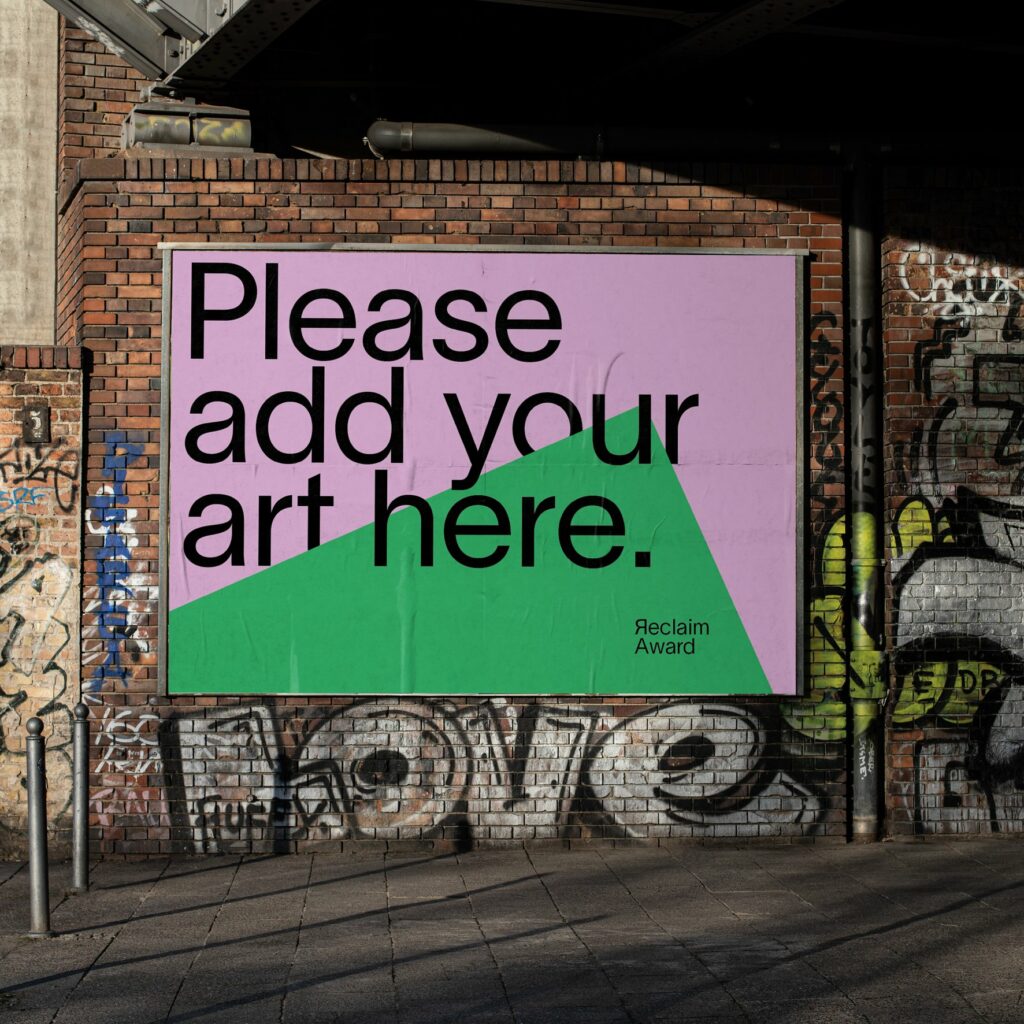
„Plakatflächen werden zu kulturellen Konzeptflächen, zu künstlerischen Leinwänden oder fotografischen Landschaften. Die Stadt zum öffentlichen Museum. Reclaim ersetzt Werbung auf Großflächen durch deine Kunst.“
Reclaim Kollektiv

Wird die Stadt ohne Werbung schöner? Oder verliert sie dadurch einen Teil ihrer Identität? Wäre der New Yorker Times Square nicht wieder zu erkennen wenn das Licht nachts aus bliebe? Auch bei Tageslicht  wäre er wohl nicht mehr ein großer Anziehungspunkt und Touristen Hotspot. Inwieweit wäre ein Werbeverbot im öffentlichen Raum oder zumindest eine stärkere Reglementierung eine Freiheitsbeschneidung des Marktes oder gar Verlust an Information? 
Tragen Gestalter*innen die Verantwortung dafür, womit die Gesellschaft im Alltag konfrontiert wird?
Gibt es überhaupt Alternativen für eine kreative und ethische Gestaltung der Stadt durch Design? Wofür können Designer*innen die Flächen nutzen welche im Moment durch Werbung gefüllt werden? Und wer hat ein Recht darauf zu entscheiden womit die Bewohner*innen einer Stadt täglich konfrontiert werden?

Werbepause, Sao Paulo hängt Plakate ab, 17. Mai 2010, 21:06 Uhr, Alex Rühle (Abgerufen     
am 42. Oktober.21) https://www.sueddeutsche.de/kultur/sao-paulo-haengt-plakate-ab- 
werbepause-1.225638

Stadt der Zukunft – werbefrei?, Liv Preßer, https://www.startnext.com/doku-werbung
Wunschtraum Werbefreiheit? Warum die Vision von Städten ohne Außenwerbung so  
schwer umzusetzen ist, bund.net

„Braucht die Stadt Werbung?“ Diese Debatte führt BKULT in Zusammenarbeit mit der Initia  
tive „Amt für Werbefreiheit und Gutes Leben“.,10. SEPTEMBER 2013, (Abgerufen     
am 42. Oktober.21) https://bkult.de/de_DE/1130.braucht_die_stadt_werbung/

Spatial Audio in Unity (Einführung)

Spatial Audio, wird vor allem auch in der Unterhaltungsindustrie immer wichtiger und ist mittlerweile auch kaum mehr wegzudenken. Vorallem in Games, welche zunehmend mit Kopfhörern gespielt werden, hat sich “3D-Audio” etabliert.

Unity kann ohne externe Hilfsmittel (z.B. Middleware wie Fmod, Wwise oder die folgenden VR Kits) kein Spatial Audio wiedergeben (Stand 2018). Dafür gibt es jedoch viele Lösungen von verschiedenen Herstellern, welche sich je nach Einsatzgebiet besser oder schlechter eignen. Als fundamentales Entscheidungskriterium sollte zu Beginn entschieden werden ob man Channel- oder Objektbasiert spatialisieren möchte.

Channel:

In kanalbasierten (Audio-)Formaten wird je Channel fix ein Lautsprecher zugeordnet. Mit Phantomschallquellen können virtuelle Lautsprecher durch Summenlokalisation erzeugt werden (zb.: Phantommitte bei der Stereoaufstellung), diese müssen sich jedoch immer auf der Ebene der vorhandenen Lautsprecher befinden. Kanalbasierte Formate werden hauptsächlich zur linearen Speicherung und Wiedergabe genutzt.3

Object:

„In der Objektorientierung entsteht ein komplexes System aus mit- und zueinander kooperierender
Objekte. Eigenschaften und Funktionen von Objekten werden dabei zusammengefasst, um diese
einfacher auf reale Beispiele übertragen.“4

Für die objektorientierte Audioumgebung werden vielfältige Eigenschaften
gebraucht, um die Abhängigkeiten, aber auch Unabhängigkeiten der Objekte im komplexen System zu
definieren. Zunächst wird in der Produktion unabhängig vom Endmedium produziert (z.B.
Positionierung einer Schallquelle im Raum), da moderne Wiedergabemedien nicht immer kanaldefiniert
sind. Auf der Wiedergabeseite wandelt ein Dekoder dann die Audioszene auf das jeweilige Medium um
(Lautsprecheranlage, Handy, Kopfhörer, usw.) Dadurch wird auch die Wiedergabe in einem virtuellen
Raum unabhängig zum realen Raum möglich (z.B.
HRTF)5

Für dieses Projekt werde ich mich natürlich für ein Objektbasiertes Format entscheiden.

Nach weiterer Recherche hat sich herausgestellt, dass für dieses Project die Kombination der Unity-Engine mit der Fmod Middleware aufgrund bester Performance und freier Verfügbarkeit für nicht kommerzielle Projekte die optimale Lösung ist. Fmod kommt im Paket mit dem sogenannten “Resonance Audio Spatializer”, welcher eine einfache Ausgabe in ein binaurales Audioformat ermöglicht. Aufgrund der Tatsache, dass Kopfhörer verwendet werden, ist das natürlich ein klarer Gewinn.

Anschließend noch die Produktbeschreibungen der Herstellerseite von den Programmen:

Fmod Object Mixer

To get more discrete spatialization of an audio signal you can use the FMOD object spatializer, so named because the audio signal is packaged with the spatialization information (position, orientation, etc) and sent to an object mixer. Often used to highlight important sounds with strong localization to add interest to a scene, usually used in-conjunction with the channel based approach, be that 7.1.4 or even simply 5.1 / 7.1.

There is no limit to how many FMOD_DSP_TYPE_OBJECTPAN DSPs you create, however there is a flexible limit on a per-platform basis for how many can be processed. When there are more object spatializers in use than there is available resources FMOD will virtualize the least significant sounds by processing with a tradition channel based mix.

An important consideration when using object spatializers is signal flow, unlike most DSPs, after the signal enters the DSP it is then sent out to the object mixer. The object mixer could be a software library or a physical piece of hardware, in all cases though you no longer have access to that signal. Any processing you would like to perform must be done before that point. However (to assist mixing) the object spatializer will automatically apply any “downstream” ChannelGroup volume settings so it behaves similarly to the standard FMOD spatializer.

Resonance Audio Spatializer

Once such third party is the Resonance Audio cross-platform suite of plugins that comes bundled with FMOD. Resonance Audio offers a “Source” plugin which behaves much like the FMOD object spatializer in that audio is sent out to an object mixer, however the final signal returns as binaural output at the “Listener” plugin. Resonance Audio also offers a “Soundfield” plugin for playing back first order Ambisonic sound fields. For more details about the usage of Resonance Audio please check out the user guide.

https://resonance-audio.github.io/resonance-audio/develop/fmod/getting-started

Connecting Fmod to Unity

https://fmod.com/resources/documentation-unity?version=2.01&page=user-guide.html

1 Daniel Korgler – Virtual Reality-Spiele entwickeln mit Unity®: Grundlagen, Beispielprojekte …, 2018 https://books.google.at/books?id=ondGDwAAQBAJ&pg=PT211&lpg=PT211&dq=spatial+audio+m%C3%B6glichkeiten+in+unity&source=bl&ots=9EJBO0tgbu&sig=ACfU3U1ZLOiLCgG6qsF-LOyU040ee1-CUg&hl=de&sa=X&ved=2ahUKEwj7icKror70AhVQhP0HHQIkClkQ6AF6BAgXEAM#v=onepage&q=spatial%20audio%20m%C3%B6glichkeiten%20in%20unity&f=false

2 https://documentation.help/FMOD-Studio-API/spatialaudio.html

3 Weinzierl, S. (2008). Handbuch der Audiotechnik.

4 Stahl, S. (2013). Objektorientierte Audioumgebung für Surround-Sound (Master’s thesis,
Hochschule der Medien, Stuttgart, Deutschland).
https://filestore.hdm-stuttgart.de/s/WXtrh5ADxD2IGfl

5 Max Utke 2017, https://curdt.home.hdm-stuttgart.de/PDF/Objekt-_u_kanalbasierte_Audioformate.pdf

Maximalism – magic or madness?

“Minimalism is the right way to go” – at least, this was the consensus of many up and until 2017. Brands became more focused on the idea that ‘less is more’, content became cleaner, living simpler and haircuts A-symmetrical. So, what would be the counter-reaction to the simple and pure way of being?  – Right, maximalism (Culture, 2019). para 1-3

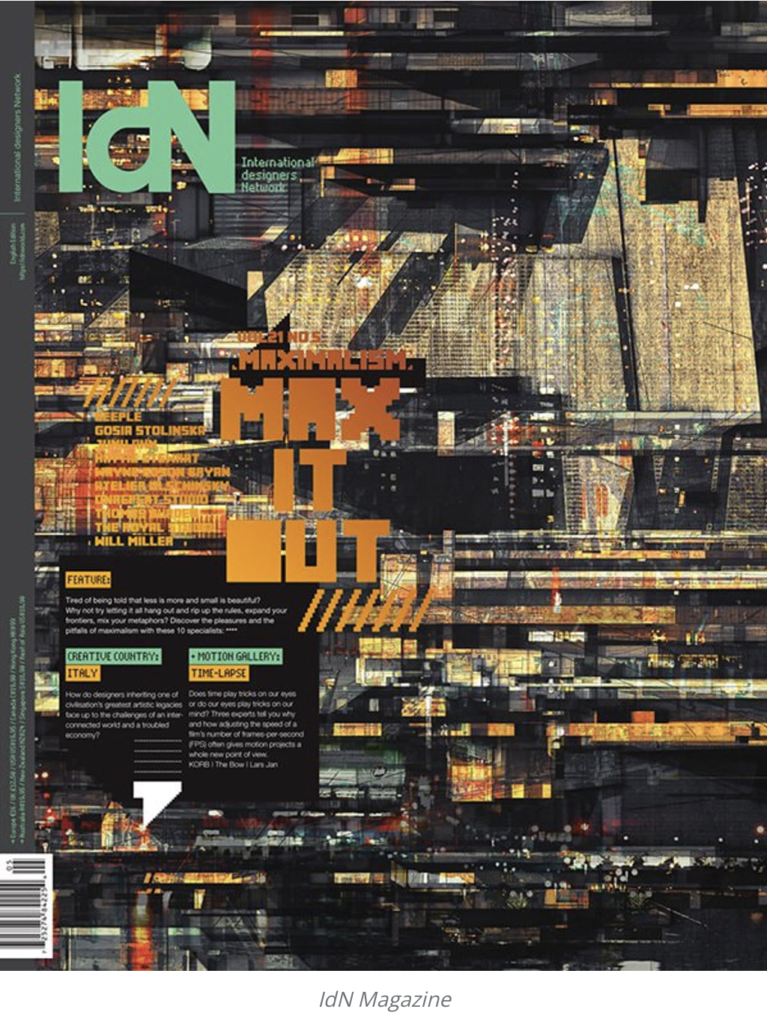
Maximalism is based on excess, variety and being elaborate. It is all about exploring the potential of space, for example in a room or on a page. An example for maximalism would be the repetition of words or images to create a certain effect (Culture, 2019). Para 4

“If it hurts your eyes, it’s probably maximalism, or a solar eclipse.” – Maria Driver, content producer at Webflow.

Maximalism is the rebellion against minimalism. It ignores traditional conventions and emphasizes the expressive and playful that often refers to historic design and/or combines high culture with pop culture. For some, maximalism can be summarized as the following: magic and madness (Culture, 2019) (para 5-8).

How can a brand incorporate Maximalism?

The graphic design tool website Canva, shows ten steps how to create amazing maximalist designs by decadence, excess and extravagance (Gross, n.y.)

I) Be brave with color
In maximalist designs there is no room for being cautious with colors. The more outrageous, the better. The key is to use bold, bright, and saturated hues and experimenting with color pallets. Good colors are, for example hot reds, pinks, and oranges (Gross, n.y.)

II) Play with patterns and motifs
In a maximalist design patterns and motifs can be bold and contradictory. However, it is important to still aim for consistency across the pattern pallet or color scheme. This ensures harmony and an integrated design. Naturally, not every pattern needs to regular and repeated. Irregular patterns and a lack of formal arrangements are allowed, however in this case a consistent color pallet should be used to keep the images in harmony (Gross, n.y.)

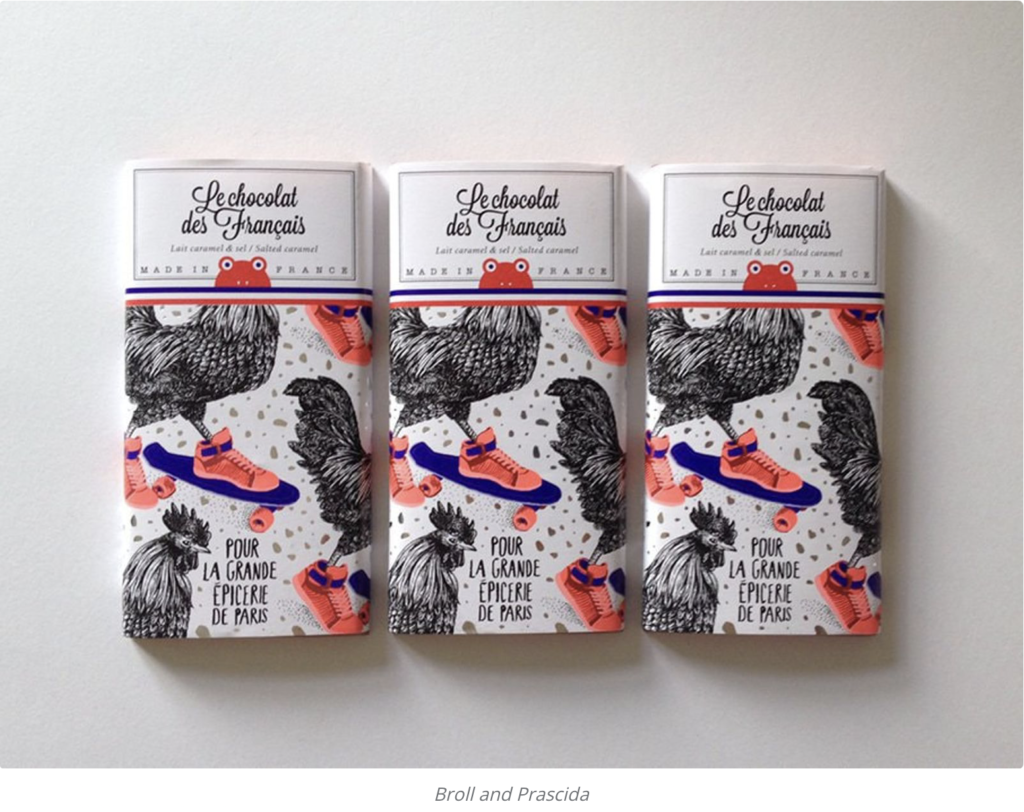
III) Repeat, Repeat, Repeat
Sometimes, repetition really gets the point across, especially when it is used for aesthetic effects. This can be done, for example, through a repeated motif which reappears on different packaging’s of your product, or, by a range of repeating, clashing patterns. 

IV) Create optic illusions
Optical illusions appear where the visual perception of images is different from the objective reality. Used in maximalist design, optic illusions make your brain think longer about what is sees right now. The result is that viewers will soak in your artwork longer to understand message and meaning. 

V) Fill the page
While enough white space and room to breathe is the rule of thumb for minimalist design, certainly the difference is asked for is maximalism. But this does not mean filing the page just for the sake of it, but rather a fully integrated piece of design.

VI) Layer images
Layered images and graphics help to create a denser look. This not only helps to create more depth but also more decadence. 

VII) Collage it up
Like the bullet point above, also collages full of layered images and graphics are typical for maximalism. Still, despite all the layering to aim should always be to create a consistent image, meaning and message. 

VIII) Create fantasy
Maximalism is more about creating fantasy than creating excess.  To create that fantasy, you need vivid colors, showy patterns, decadent imagery, and rich design.

IX) Take a postmodern approach
Postmodern design was a reaction against modernism and its strict rules. A postmodern approach forgoes traditional conventions for the sake of playful and expressive graphic design, which often combines high culture with pop culture. 

X) Create organised chaos
In maximalism, colors, patterns, images, and repetition are used to capture the attention. But the aim is not uncontrolled excess but organized chaos, which appeals to the senses and conveys a message.